MIXING VS MASTERING OVERVIEW
A question I see asked often is “What is the difference between Mixing vs Mastering?” and in this article, I will create a comprehensive guide to the distinctions, as well as provide audio examples. Mixing and mastering are two essential, interdependent but separate stages of the modern music production process. While both contribute to the final sound of a recorded piece, they serve fundamentally different purposes. Mixing shapes the musical elements within a song—balancing levels, positioning sounds in the stereo (or surround sound) field, applying creative effects to individual tracks, enhancing both tone and emotion. Mastering, by contrast, prepares a finished mix for distribution by ensuring consistency, translation, and competitive loudness across a wide range of listening environments and formats. There is also a quality control (QC) element to mastering that we will delve into later. Together, these processes transform raw recordings into polished, compelling works ready for listeners.
Both crafts have evolved significantly as recording technology and listening habits have changed. The shift from analog tape and vinyl to digital audio workstations, the rise of streaming platforms, the emergence of loudness normalization, and the ubiquity of mobile listening have all reshaped the expectations and responsibilities of mixers and mastering engineers (MEs). Tools once available only in high-end studios—precision equalization, multi-band compression, advanced limiters, and detailed metering—are now accessible to virtually anyone with a computer. Yet despite this democratization, the expertise required to make informed, musical decisions remains at the core of each discipline.
Although mixing and mastering share certain tools and occasionally overlap in technique, they are distinct processes with different goals, mindsets, and deliverables. Treating them as interchangeable can undermine the quality and impact of a release. Understanding their differences—and how they complement one another—is crucial for artists, producers, and engineers who aim to create professional, emotionally resonant, and commercially viable music.
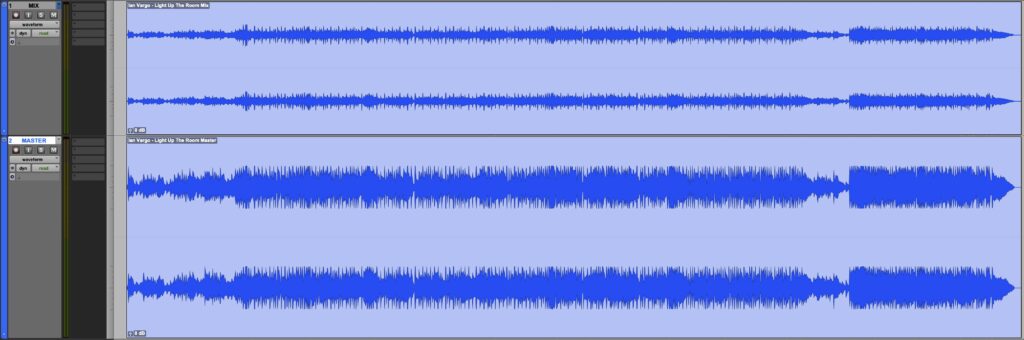
Comparing a music mix (top) to a master of the same song (bottom). You can see that the master’s waveform is noticeably denser and larger, reflecting its increased loudness, which was achieved through increasing the gain, adding high end equalization, limiting, and more mastering processes.
WHAT IS MIXING?
Mixing is the stage in the music production pipeline where all recorded elements—vocals, instruments, programmed parts, and sound design—are blended into a cohesive, expressive, and polished whole. Traditionally, the mixing process begins once recording is complete; however, in contemporary workflows, producers often “mix as they go,” shaping tones, levels, and effects during recording and arrangement. In many modern genres, the producer and mix engineer may even be the same person, meaning mixing decisions can influence later recording choices, and additional parts may be overdubbed long after the mix has begun. Regardless of the workflow, the goal of mixing remains the same: to ensure that every musical element occupies the right space and serves the emotional intention of the song.
Historically, the role looked very different. In the early days of multi-track recording—such as at Abbey Road in the 1950s and 60s—mix engineers were known as balance engineers, and the term captured their primary responsibility: balancing a small number of recorded tracks into a unified mono (and later, stereo) master. With limited track counts, minimal outboard gear, no automation, and no digital editing, engineers made many creative decisions during the recording stage itself. Microphone placement, preamp selection, use of chamber reverbs, tape saturation, and real-time fader moves shaped the mix as it was printed. Because they could not rely on extensive post-production processing, balance engineers had to commit early, work decisively, and collaborate closely with producers and performers to achieve the desired sound.
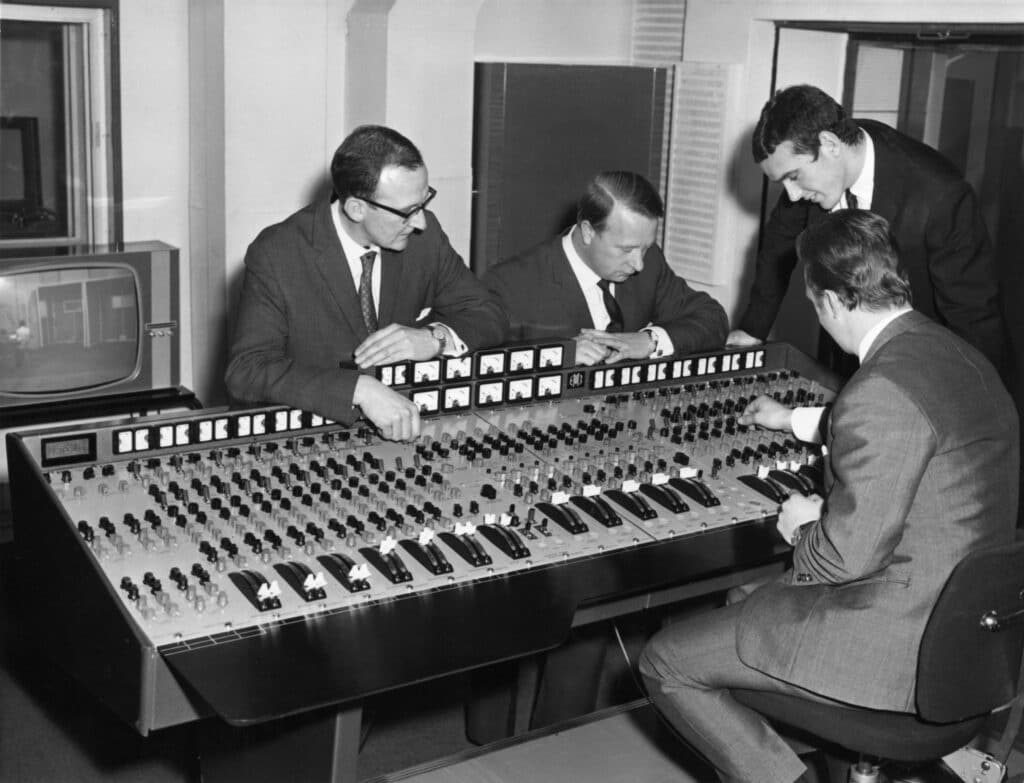
Engineers surround an EMI TG12345 Console.
Today’s mixing engineers operate with far more flexibility and a vastly expanded toolkit. Inside a digital audio workstation, they can shape individual tracks with precision. They use equalization to carve out space and define tonal character, compression to control dynamics and add punch or consistency, and reverb and delay to place sounds in a spatial context. Beyond the classic tools, modern mixers have access to saturation, multi-band dynamics, stereo imaging, transient shaping, pitch correction, and countless forms of creative processing. Automation allows them to sculpt movement throughout a track, enhancing emotional impact and ensuring clarity at every moment.
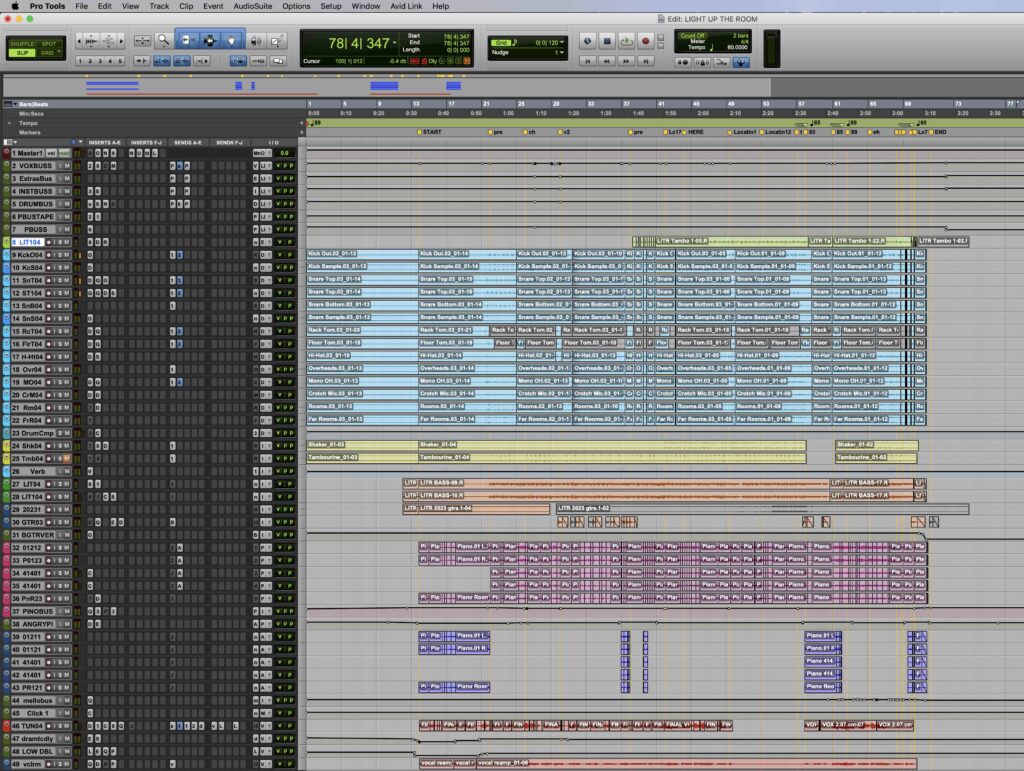
A mix session within the Pro Tools Digital Audio Workstation (DAW). This session contains roughly 50 tracks including over 10 tracks for drums, as well as bass, guitar, piano, vocals, effects, and more. Many mix sessions will be substantially larger than this, with track counts easily reaching the 100s.
Although mixing and mastering are distinct stages, there is natural overlap that can lead to confusion—especially today, when many mix engineers apply processing on the master bus to shape the overall tone, cohesion, and loudness of a track. Tools like bus EQ, compression, saturation, and even limiting are often used during mixing to help the song feel more finished and competitive. These techniques resemble aspects of mastering, where the engineer refines the overall sonic balance, ensures consistent playback across all systems, and achieves appropriate loudness relative to contemporary releases. The shared tools and goals can blur the line, but the intent and context of their use remain fundamentally different.
Despite the technological advances, the essence of mixing remains an artistic craft rooted in critical listening, musical intuition, and technical skill. A great mix supports the song, elevates its intent, and prepares it for the final step in the production chain: mastering.
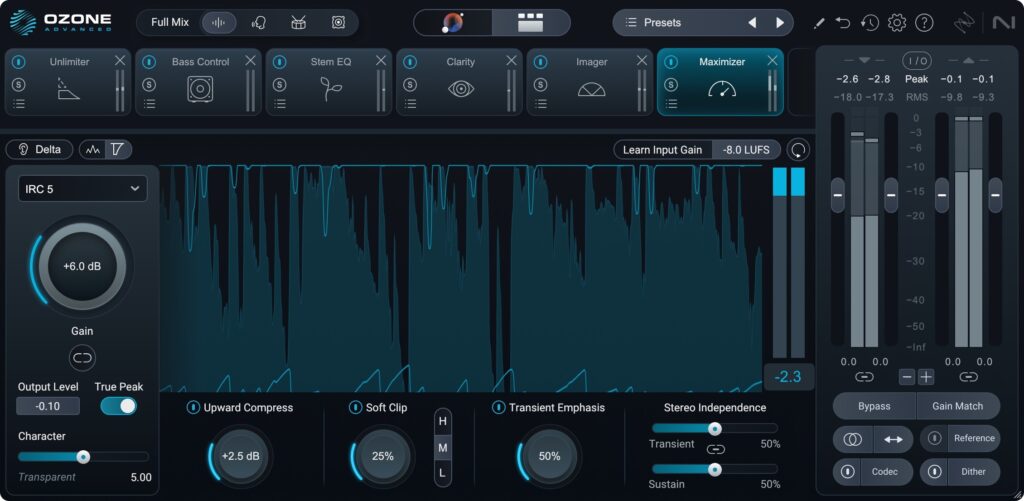
iZotope OZONE 12, a suite of mastering processors that can serve as a helpful tool for producers and mixing engineers, but will never replace the value of a dedicated Mastering Engineer and high-end mastering tools.
WHAT IS MASTERING?
Mastering is the final stage of the music production process, historically rooted in the era of vinyl records. In its earliest form, mastering involved transferring a finished mix onto a lacquer master disc that would be used to press vinyl copies. This wasn’t a simple transfer—engineers had to apply careful processing to ensure that the grooves cut into the lacquer were stable and playable. Excessive low end, harsh highs, or wide stereo information could cause the needle to skip or distort, so mastering engineers used EQ, compression, and level control to keep the music within the physical limits of the medium. They also sequenced entire albums, adjusted levels between songs for cohesion, and prepared the lacquer for mass replication, making the mastering engineer a crucial bridge between artistic creation and commercial distribution.

An RS56 stereo equalizer, nicknamed the ‘curve bender’, used by engineers at Abbey Road to apply finishing touches during mastering before vinyl pressing.
As formats evolved, so did the role. With the arrival of the CD era, mastering shifted from a purely analog, mechanically constrained process to a digital one requiring new technical responsibilities. Mastering engineers became responsible for embedding metadata such as artist names, track titles, and ISRC codes; creating seamless transitions or crossfades between songs; and finalizing the project in the form of a DDP (Disc Description Protocol) file used for large-scale CD manufacturing. The focus expanded from preventing playback issues to ensuring sonic consistency, clarity, and competitive loudness across diverse playback systems—from home stereos to car systems to early digital players.
Modern mastering retains the artistic and technical foundations of its earlier forms but with far more advanced tools, including many digital plugins, and an emphasis on translation across countless listening environments, including streaming platforms with loudness normalization. Mastering engineers use precision equalizers, compressors, and especially limiters, which are critical for controlling peaks and achieving final loudness without distortion. Some engineers also employ analog gear, including tape machines, to impart warmth, glue, or subtle saturation. Despite the accessibility of digital processing, high-end mastering still relies on exceptional monitoring chains: meticulously acoustically treated rooms, large full-range speakers with extraordinary accuracy, high-quality amplifiers, and world-class AD/DA converters. These environments reveal details that typical studios—and certainly home setups—might obscure, enabling mastering engineers to make decisions that ensure a track translates perfectly everywhere.
At its core, mastering is about refinement, consistency, and readiness for release. It’s the stage where the final artistic polish is applied, making sure the music holds up against modern standards, sounds professional on any playback system, and is prepared in the correct technical format for its destination.
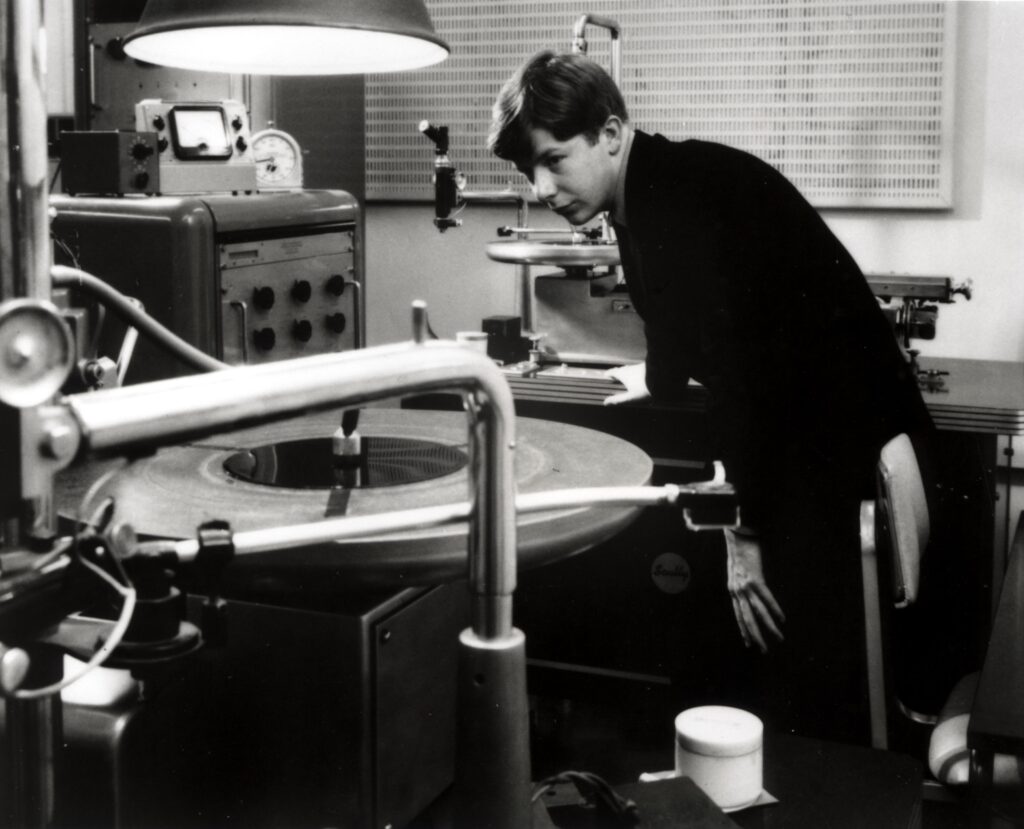
The Beatles’ engineer Ken Scott pictured with a Neumann VM80 Lathe at Abbey Road in the 1960s, a device used to create master discs for vinyl record production.
KEY DIFFERENCES AND COMMON MISCONCEPTIONS
Although mixing and mastering share certain tools and occasionally overlap in workflow, their purposes, mindsets, and scopes are fundamentally different. Mixing focuses on the individual elements within a song—balancing vocals and instruments, sculpting tone, creating spatial depth, and enhancing emotion through detailed track-by-track adjustments. Mastering, on the other hand, addresses the song as a finished whole. It fine-tunes the overall tonal balance, dynamics, loudness, and translation so the final deliverable sounds polished and consistent across all playback systems and formats.
Despite this clear separation, several misconceptions persist. A common one is that mastering can “fix” a bad or incomplete mix. While mastering can enhance clarity and polish, it cannot remedy fundamental issues like poor arrangement, imbalanced levels, muddy frequency buildup, or overly loud vocals—problems that must be addressed at the mix stage. Another misconception is that mastering is simply making a track louder. Although achieving appropriate loudness is part of the job, mastering is equally concerned with preserving dynamics, ensuring tonal consistency, and preparing the final technical assets for release.
Confusion also arises because many of today’s mix engineers use tools such as bus EQ, compression, and even limiting on their stereo mix bus to achieve a more finished sound before mastering. While these techniques overlap with mastering concepts, the intent is different: mix-bus processing supports creative balance within the mix, while mastering focuses on global optimization, playback compatibility, and meeting distribution standards. Understanding these distinctions helps producers, artists, and engineers collaborate more effectively and ensures that the final music reaches listeners in its best possible form.
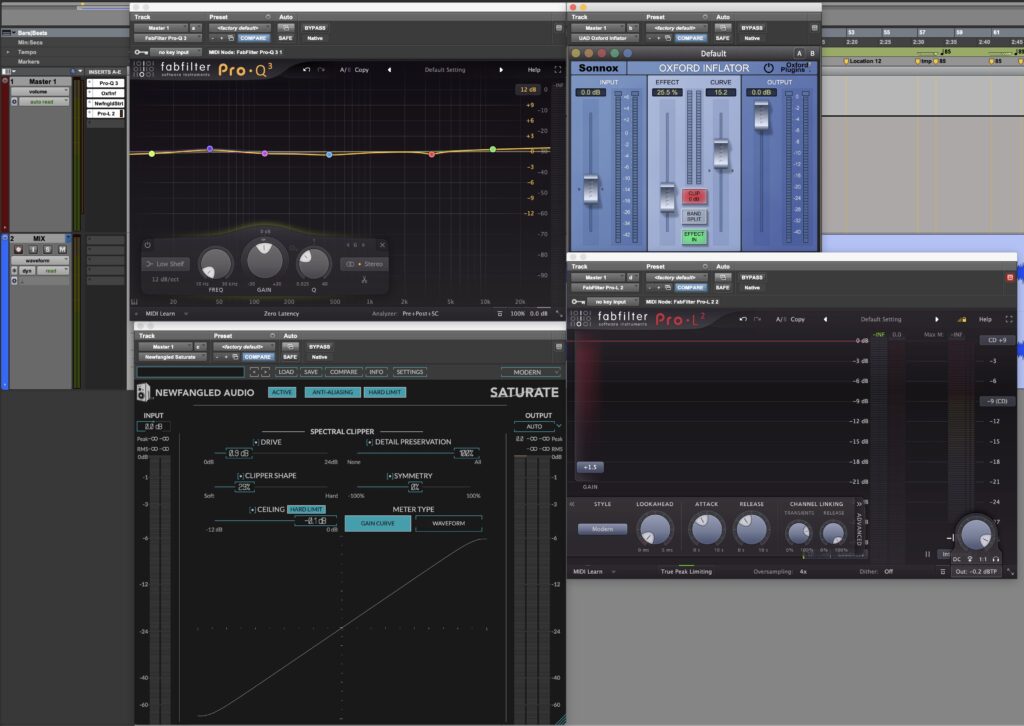
Processing applied to my mix bus, which includes the FabFilter Pro-Q Equalizer, the Oxford Inflator (a harmonic enhancer), Newfangled Audio Saturate (a clipper), and the FabFilter Pro-L 2 Limiter. Each are only applying a small amount of processing. Despite being used on my mix session here, these tools might also show up when I master a song.
TOOLS COMMONLY USED IN MIXING
Next I am going to list some tools commonly used in mixing and mastering. It’s important to note that sometimes there is overlap in these tools and techniques.
- DAWs: Ableton Live, Logic Pro, Pro Tools, Cubase — chosen for many personal preferences in workflow flexibility, included plugins and compatibility with third-party plugins.
-
Processors (EQs, Compressors, Reverbs, Delays): Applied to individual tracks to shape tone, control dynamics, and create space. EQs carve out frequency ranges so instruments don’t clash; compressors control peaks and add punch or sustain; reverbs establish depth and a sense of environment; delays create rhythmic or spatial interest. These tools are often used creatively—parallel compression, gated reverb, tempo-synced delays, and filtered or automated EQ moves—to enhance the emotion and character of the performance.
-
Automation of Individual Tracks: Adjust volume, pan, and effect parameters over time to create movement, highlight performance nuances, or emphasize key moments.
-
Mix Bus Processing: Subtle compression, EQ, or tape-style saturation applied to the stereo bus to unify the mix and glue the elements together.
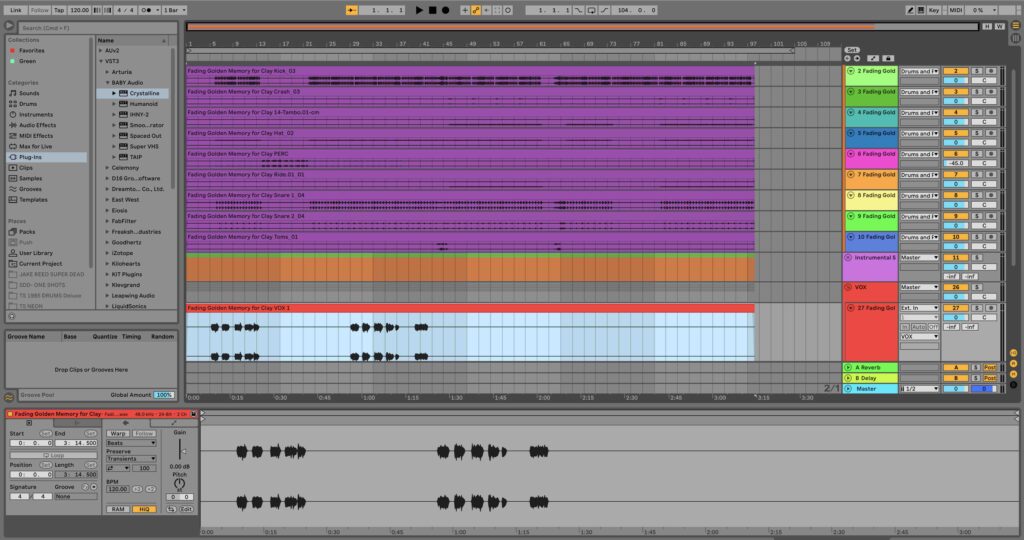
A mix being created within the Ableton Live Digital Audio Workstation, my favorite DAW for music creation due to its inspiring workflow and impressive stock plugins and instrument set.
TOOLS COMMONLY USED IN MASTERING
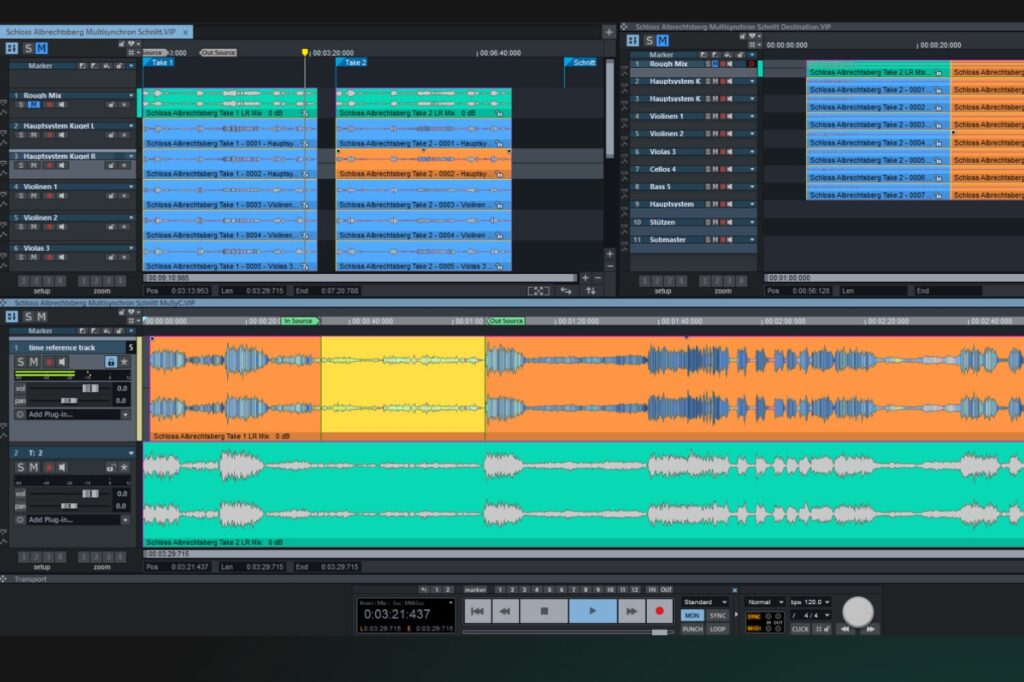
- DAWs: Sequoia, WaveLab, HOFA, Pyramix — chosen for precision, high-quality output, and mastering workflow features.
-
High-Resolution EQs: Precise tonal shaping for the final mix. While something like FabFilter Pro-Q 4 might show up in both mixing and mastering, it is likely to be applied for subtly in mastering.
-
Mastering Compressors & Limiters: Glue, dynamic control, and peak management. Again, you might see the same plugins applied for compression when mastering, but they are usually applied in a less heavy-handed manner. There are many serviceable free mastering plugins available.
-
Stereo Imaging & Mid/Side Processors: Adjust width and center/side balance.
-
Metering Tools: LUFS, RMS, true-peak, spectrum analyzers, and phase correlation.
-
Dithering Tools: For final bit-depth reduction when preparing delivery formats.
-
Monitoring Systems: Full-range, extremely accurate speakers in acoustically optimized rooms.
THE LOUDNESS WAR AND HOW IT AFFECTS BOTH MIXING AND MASTERING
The struggle for loudness has been a part of recorded music almost as long as records have existed. Early on — think vinyl 7-inch singles and jukeboxes — louder records could stand out when played alongside quieter ones. Labels and artists often pushed for “hotter” masters so their track would command attention on radio, jukeboxes, or club rotations. That ambition sometimes ran up against the physical and mechanical limits of the vinyl medium: too much bass, stereo width or excessive high frequencies could cause groove distortion or even make the stylus skip.
With the arrival of the digital era (CDs, then digital formats), those vinyl constraints largely disappeared, and mastering engineers gained access to powerful tools — compressors, limiters, clippers, and digital EQs — that could push RMS / perceived loudness much higher without immediately causing mechanical problems. That unleashed what we now call the Loudness War: mastering for maximal volume became common. Engineers and labels often prioritized high loudness at the expense of dynamic range, naturalism, and subtlety. Many records were re-mastered using these techniques, resulting in drastically louder versions of songs being released.
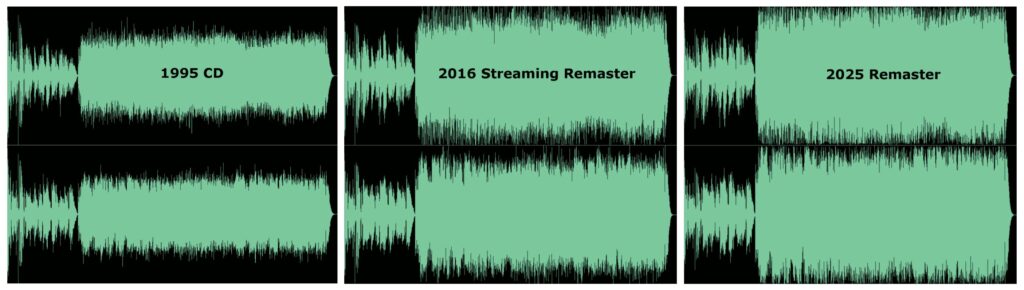
An image showing the ever-increasing loudness of “My Bonnie” by The Beatles and Tony Sheridan. Displaying the 1995 CD release, the 2016 Streaming re-master, and the 2025 Anthology re-master.
Because of this, certain practices in mixing also shifted. Mix engineers, anticipating a loud final master, began shaping mixes with that in mind — sometimes compressing, limiting, or pushing levels harder during mixing. More aggressive balance choices or mix-bus processing became common as part of achieving a “competitive” final loudness. But the result across many releases was a homogenized sound: less dynamic contrast, more “always loud,” which some listeners might find fatiguing.
In recent years, the rise of streaming — and the adoption by major platforms of loudness normalization — has, in some ways, changed the landscape. Platforms now measure loudness using standards like LUFS (Loudness Units relative to Full Scale, per ITU’s recommendation) to equalize playback volume across tracks.
Target Integrated LUFS by Platform
Spotify: –14 LUFS
Apple Music: –16 LUFS
YouTube / YouTube Music: –14 LUFS
Amazon Music: –13 to –14 LUFS
Tidal (and many others): –14 LUFS
These values reflect recommended or common target loudness for streaming normalization; “true-peak” ceiling (to avoid clipping during encoding) is also often specified by platforms.
Because streaming services now turn down (or, if necessary, raise) the playback volume of tracks to match their normalization target, the incentive to push for extremely loud masters solely for the sake of competitive playback volume has diminished. The logic is this: Pushing a master to –8 LUFS (common in the loudness-war era) will often be “penalized” — turned down during playback — effectively negating the perceived loudness advantage, while still sacrificing dynamic range and causing potential listener fatigue.
One might think that as a result, many mastering (and mixing) engineers today would be drastically shifting back toward dynamic range, clarity, and musicality over outright loudness. With the new priority not simply being “loudest,” but “best sounding everywhere” — optimized for streaming, playback translation, and listener experience.
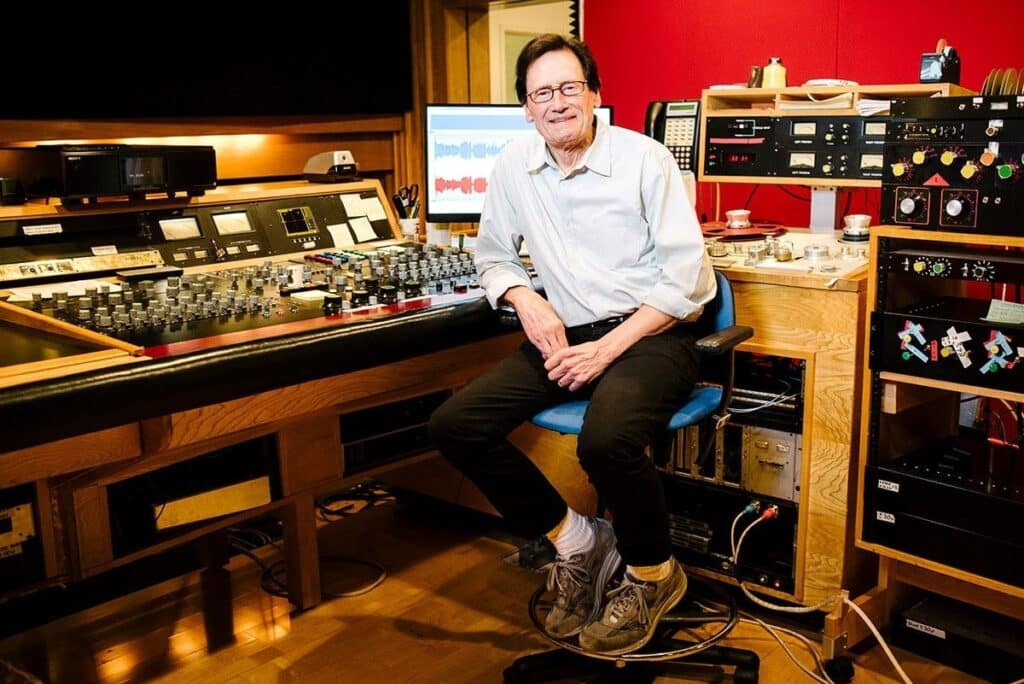
Legendary Mastering Engineer Bernie Grundman (Prince, Dr. Dre, OutKast) at his mastering studio in Los Angeles.
However, it’s my personal view that pushing towards competitive loudness will almost always be a consideration at both the mix and master stages of a production. Artists, engineers, and listeners have gotten used to the sound of liberal applications of additive EQ, compression, clipping, limiting, and other processes used in the early days of the loudness war, and without those things, music doesn’t sound quite right. And I can’t really argue, each of these processes impart a certain character to audio recordings, and these sonic characteristics have become what we collectively view as professional-sounding.
Many MEs, myself included, still push into the -8 LUFS (and beneath) range, depending on the style of music, and limitations of the arrangement and mix, and I do not see this changing.
CAN YOU MASTER YOUR OWN MIXES?
The short answer is, yes. Ideally, you hire a mastering engineer to impart that delightful final touch onto a mix, while also handling the QC and metadata needs, but if the budget doesn’t allow, or you’d simply rather do it yourself, then yes. In fact, part of why I got into mastering is because earlier in my career I experienced a professional mastering engineer ‘overcook’ one of my own mixes through excessive compression and addition of high frequency content. I will say that part of why you’d hire a mastering engineer in the first place is to bring in an outside set of ears that can assess the mix objectively.
If your goal is to simply apply audio processing to your mix, so that it is optimized for playback, and upload to streaming, this does remove a fair amount of what an ME is responsible for. While you certainly can master you own music, I still recommend to work with a mastering engineer for their unique skillset, high end room and equipment, and objective option.
THE FUTURE OF MIXING AND MASTERING
As music formats continue to evolve, the role of mixing and mastering evolves with them. Stereo remains the dominant listening format for most audiences—streaming services, headphones, car systems, and consumer speakers are all fundamentally built around two channels. However, we’re also seeing a rapid increase in demand for Dolby Atmos and other immersive formats, especially from major labels and streaming platforms.
Atmos is an object-based audio format that moves beyond traditional channel-based mixing. Instead of assigning sounds strictly to left and right, Atmos allows engineers to place audio “objects” anywhere within a three-dimensional field—around the listener, above them, or moving within the space. When done well, this can create a highly immersive experience that feels more cinematic and spacious than stereo.
That said, Atmos is still navigating several limitations. Consumer playback systems vary wildly: some listeners have full Atmos speaker arrays, others use soundbars, headphones, or devices that downmix Atmos back into stereo. This inconsistency makes translation unpredictable. Additionally, creative intent can become diluted when an Atmos mix is collapsed into stereo or binaural, and not all music genres benefit equally from the format. The workflow itself is also more complex, requiring additional tools, monitoring environments, and specialized mastering approaches.
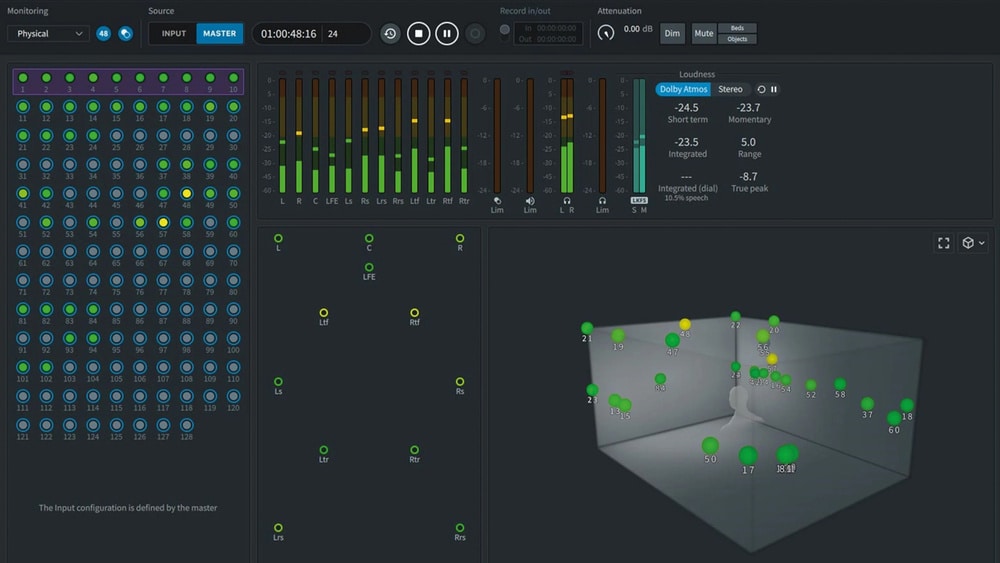
Mixing in Dolby Atmos, an object-based mixing environment.
Even with those challenges, immersive formats may influence the industry in meaningful ways—encouraging more spatial thinking in arrangements, new types of sound design, and alternate distribution paths for artists. As technology and playback systems improve, Atmos and similar formats may become more standardized and accessible.
But despite the push toward immersive audio, while we may adapt a format such as Atmos, I personally believe stereo will never be fully replaced. Its two-channel design aligns perfectly with our biology—two ears, two sources—and remains the most direct, natural way for us to perceive recorded music. Check back in 20 years, and I’d be happy to be proven wrong.
AUDIO EXAMPLES
Beneath are a few examples comparing the mix to the final master. You’ll notice the masters are certainly louder, and will generally have more high end, a tighter and fuller bass, and some stereo field enhancement.
Take Care (File A is the mix, File B is the master)
I’ll Be There (File A is the mix, File B is the master)
MIXING VS MASTERING SUMMARY
Mixing and mastering are deeply connected stages of audio production, but they rely on different goals, mindsets, and toolsets. Mixing is about building the record—shaping individual tracks, balancing elements, creating depth, and using processors to craft a compelling musical experience. It’s hands-on, creative, and detail-oriented, where decisions are made at the micro level.
Mastering, on the other hand, focuses on polishing the final mix so it translates consistently across all playback systems. Mastering engineers use a more specialized, minimal signal chain: high-precision EQ, transparent compression, limiting, stereo enhancement, saturation, and metering tools that go far beyond what’s typically used during mixing. The approach is macro-focused—subtle adjustments that affect the entire song or album, ensuring cohesion, competitive loudness, and tonal balance.
Understanding both disciplines gives you a more complete picture of how records come together. If you’re a mixer, spending time with mastering tools builds your awareness of translation, headroom, and how your decisions upstream affect the final product. If you’re learning mastering, experimenting with mixing gives you a deeper appreciation for where the artistic shaping happens before the final polish. While each craft can be a lifelong pursuit on its own, practicing both—even at a basic level—makes you a more informed, versatile producer who knows what each stage needs to shine.
ABOUT THE AUTHOR
Ian Vargo is a Music Producer, Mix & Mastering Engineer, and Multi-Instrumentalist whose work has been heard on broadcast television, nationally televised ad campaigns, award-winning films, and viral web content amassing over 30 million views. His credits include projects for Disney | ABC, Intel, MSNBC, Airbnb, EA Games, and many more.
With over 20 years of experience in the studio, Ian has contributed to major label releases (Capitol, EMI, Fueled by Ramen, Universal, Interscope, Hollywood Records) as well as acclaimed independent projects. His passion lies in helping artists translate their creative vision into professional, release-ready recordings that stand out in today’s music landscape.
Interested in working together? Reach out at ianvargo@gmail.com if you need mixing or mastering for your next project.