Recently I was fortunate enough to have a conversation with members of the incredibly talented team responsible for the sound of The Righteous Gemstones, which recently concluded its final season. Sound Supervisor Nicholas Renbeck has had a storied career, having worked on Love & Mercy, the Brian Wilson biopic, HBO’s smash hit Succession, and The Night Of, for which he won 2 Emmy Awards. Music Editor Michael Brake has a similarly impressive resume, working in both film and television, on projects like How I Met Your Mother, Midsommar, Insecure, and Barry, for which he also won 2 Emmys. In this interview, we discuss their careers, and their approach to bringing The Righteous Gemstones alive through sound and music.
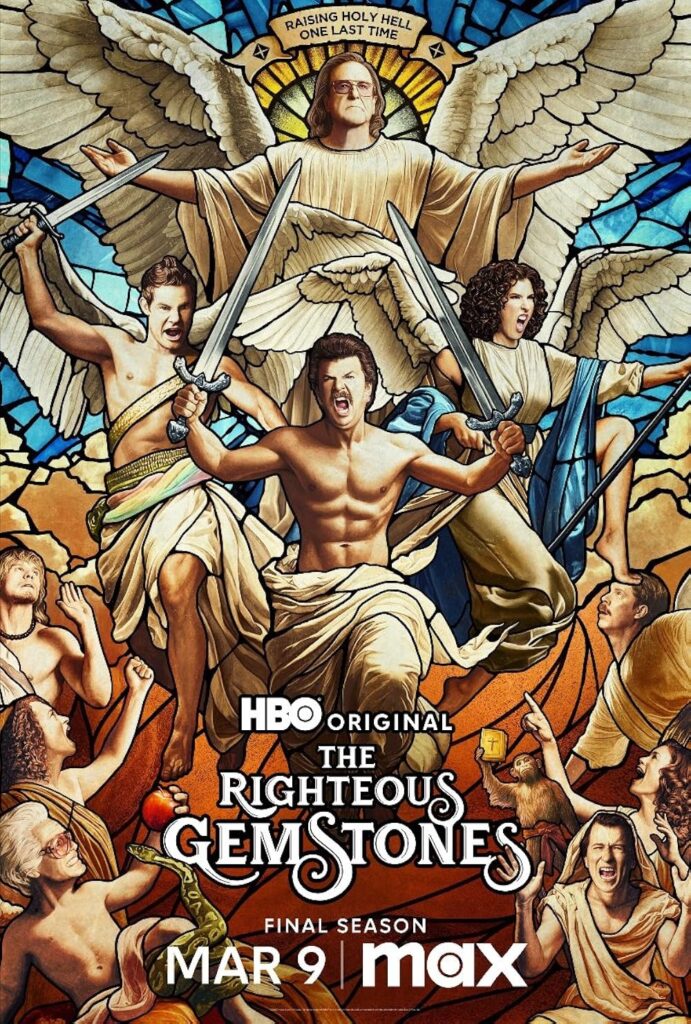
Ian Vargo (IV): If you could give me an abridged version of your backgrounds and how you ended up doing what you’re doing now?
Michael Brake (MB):
I went to the School of Filmmaking in North Carolina, School of the Arts. In the very first filmmaking class, Danny McBride, Jody Hill, and David Green all went. They were there a couple years behind me. I didn’t really know them there, but I had a lot of mutual friends. I moved to New York. I tried to get a job at C5 where Nick was working, but that didn’t pan out. So I wound up in LA and met a director while I was doing theater sound design, and the director’s sister was a music editor. I was like, “That sounds perfect. I want to do that. How do I do that?” She let me tag along and taught me the ropes. That was Leslie Langs, and that was 25 years ago, and I’m grateful every day that she gave me the life that I live right now.

Emmy-Award Winning Music Editor Michael Brake (image source: imdb)
I started with her. I did a Disney film and an ABC show, and then she took some time off, and I wound up doing reality shows. I did Survivor, and I was the supervising music editor for all of Mark Burnett for many years, which is one of the best training grounds because it is wall-to-wall music. Having a 45-minute show with 48 minutes of music—what the hell happened? That’ll teach you. I really am appreciative for what that experience gave me, learning to become quick on a keyboard because you’ve got an hour-long show to go. Then I started into narrative, and it’s been going great since. That’s been 20 years now.
Nicholas Renbeck (NR):
Well, I graduated high school and went right to working for Danny McBride on Gemstones. No, that’s not quite what happened — I’m slightly too old for that. I went to Ithaca College to study film and photography. While there I took a job in the film school transferring the production sound recordings for the student films. It was all 16mm at that point, so production sound was recorded on quarter-inch Nagra tape or even cassette tapes. I had the job transferring it to 16mm, and I got to see the school’s audio gear and the film dubbers. I thought, “Oh, this is kind of fun,” and my attention started going more toward that end of the film making process.

Emmy-Award Winning Sound Supervisor Nicholas Renbeck (Photo: Clay Enos/Cinemontage)
I ended up mixing about 100 student films while I was there. There was a lot o learning by doing, and making a lot of mistakes along the way. Then my sophomore year, Ron Bochar — one of the owners of C5 sound in NYC, who had graduated from Ithaca a few years earlier — came back to give a speech on Silence of the Lambs. He brought in these three-quarter-inch videotapes of Clarice going down to see Hannibal Lecter in his cell for the first time. I remember Ron saying, “Here are just the background air tone passes,” and he played that. I thought that was cool. Then he said, “Here are just the door passes,” and he played that. He said, “If you’ll notice, there’s a pig squeal on this door opening,” and I thought, “Oh, nice — you can use something other than a door sound for a door to add some character to it.” I thought, “This guy’s cool. I’m going to pay attention.”
I started bugging him. I sent him one or two letters over my sophomore, junior, and senior year, and I think he finally got annoyed at my bugging him. After I graduated, he said, “All right, come down to C5.” So I sat in the back of the room, and didn’t say anything for a long time — just watched. I guess when I did speak I asked the appropriate questions, and he decided to give me a chance. I apprenticed on Jonathan Demme’s Philadelphia and Alan Pakula’s The Pelican Brief — my first two shows. I got to know the New York City film community and did a lot of features for a long time.
I went from apprentice to assistant, dialogue editor, ADR editor, and then supervising and mixing before I had an opportunity to cut sound effects. It seemed that everyone likes to cut sound effects, so I had to make myself the supervisor before I could give myself the opportunity to try cutting and doing some sound design work.
Over the years it’s been fewer features and more television work. I fell into Gemstones really by a happy accident. You guys (Michael, Danny, and Rough House Team) had been doing the last show (Vice Principles) in LA, and my understanding is that LA was a long flight for Danny because they had relocated to South Carolina. It was a much quicker flight up here to New York.

The Principal Cast of The Righteous Gemstones
IV: You each have worked on shows that are really important to me. Insecure was one of my favorite shows on HBO over the past 10 years, and Succession as well. There are very few shows that are appointment television now, but those were ones I had to see as soon as they came out.
MB: I can talk about Insecure for a minute and tie it to Gemstones in a way. The thing that I loved about Insecure working with Issa (Rae) is the way she loved music. She talked about music, and she loved music so hard. She was so invested in the choice of each song. She would hear something because people would send in demos to use. She would fall in love with the demo. They’d send back a new, cleaned-up version, and she was like, “Why is it different? Put it back.” The demo was raw, it was great — put it back. So every now and then they had to revert to a demo for us. She was much more invested.

Issa Rae of Insecure, a show that helped expose many musical acts to the masses. (source: VIBE)
But in the same sense, I feel like Danny (McBride) — he loves music. And the relationship that he and DeVoe Yeats, our music supervisor, created, where DeVoe has one of the most library-built minds I’ve encountered in this industry. He uses the most interesting and off-the-wall songs in the best ways possible, and he and Danny really nerd out and have fun listening to music that way. I love EPs that love music. It makes my job so much fun.
IV: And there’s so much great music in all of Gemstones.
MB: Yeah, that’s DeVoe with the songs. And Joey, our composer — he’s insane. I think he could write anything, from the synth-y, arpeggiated stuff that we did throughout the cycle ninjas, to that really soft, gentle piano in season one. I know Nick and I had talked about those things in season one, when it was Eli’s theme: really soft, gentle piano, when he was remembering Amy Lee. It was so heartfelt. I was like, “Oh man, it’s just beautiful.”
And then we get the cycle ninjas, and then that whole “Jesus Loves the Gemstones” theme. I was like, “This is the most fun music I’ve ever worked on.”
IV: Nick, I wanted to circle back and mention how interesting it is that your entrance into the industry was reliant on technology that basically no longer exists.
NR: Yeah. At film school I was working on 16 millimeter film. And then, when I arrived in New York that was a step up to 35mm film for sound mixing, but sound editors were doing a lot of the sound design work on Synclaviers, and the rest of the sound editing work was moving from 35mm film cut on benches and upright moviolas to a new DAW system; Sonic Solutions. All of which have now been superseded by Protools — but for a good while Sonic Solutions was the industry standard in New York. Dialogue editors and ADR editors were using that. Sound effects editors were still using the Synclaviers.
Once the sound editing was done we would transfer everything back to 35mm film fullcoat which would then have to be brought from C5 in Chelsea upto midtown, either to Sound One or Todd AO, the two main mixing houses in those days.
As an apprentice I would often have two to five boxes of multiple 1000- or 2000-foot reels of magnetic film that I would have to cart across the city via cab, which was always a challenge as the cab drivers didn’t want to stop for a kid with a hand truck and a bunch of heavy looking cardboard boxes. Myself and my fellow apprentice/assistant sound editors would have to pull a bait and switch with the cabbies to catch a ride. One of us without the boxes would flag down the cab, and then quickly hop in and ask the driver to pop the truck while the other assistant would load up the trunk.
Based in no small part on not having to cart materials around the city anymore I am happy we’ve all gone digital. I don’t need to go back. I appreciate the fact that I got to do that. I loved the handling of film, with all the mechanical aspects that comes from sprockets on magnet full coat, and that was all fun — cutting the actual film. But we’ve moved beyond that and what we have now is so much better. Though I’ll still reminisce and tell my apprentice what it used to be like.
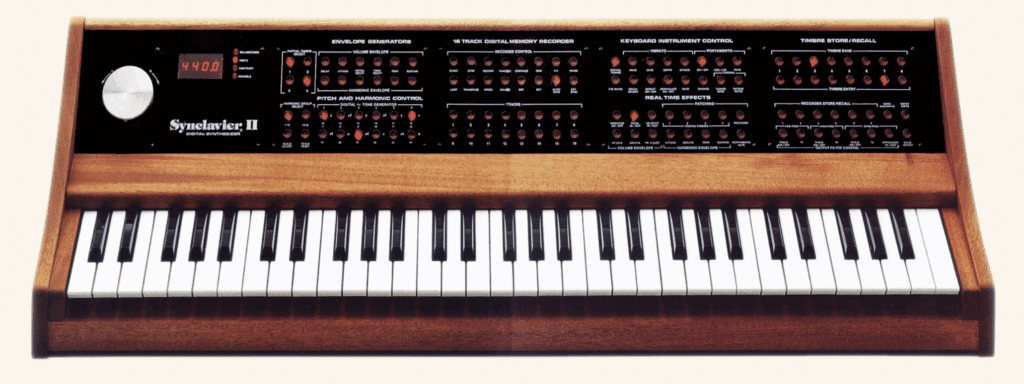
A Vintage Synclavier Synthesizer
IV: Something that always impressed me about Gemstones is the scope. Obviously, it’s a hilarious comedy, but it also has top-notch action, expansive scenes with huge crowds in the church, and a lot of live music performed by the cast. What was it like working on a show with so much situational variety?
NR:The show kept you on your toes that for sure. Definitely felt like every episodes gave us something new to take on and explore. Wave pools, huge mega church concerts, monster trucks, locust swarms, dungeon sex clubs, motorcycle gangs, alligator, jet packs — exactly. There’s always something new. They did a nice job of finding different locations or trying to come up with something bigger or new. So for me, in terms of keeping things interesting, it’s great. Sometimes it’s a little like, “Oh, I’ve only got five days to do this, and you’re giving me this?” But that’s part of the challenge and part of the fun with the show.
IV: How much time would you have typically per episode?
NR: Alexa Zimmerman our dialogue editor had five days to edit an episode, Deborah Wallach our ADR editor had five days for cuing, recording, and editing the loop group and principles per episode. But with mixing starting a few weeks later than the sound editing schedule that allowed some flexibility to try and pool recordings sessions together which was helpful. (Of course it often depended on actor’s availability.)
In terms of Foley and sound effects, it felt a little tight that first season. With Foley I think we originally had only three days of editing and 12 hours of recording for a half hour. Though that did expand out to five days for editing by season two. On season one I was the only sound effects editor, plus the supervisor, and then second-chair mixer (covering FX/Foley). I’d have five days to do all the effects and the supervising duties, and then two days on the mixing stage. It was a bit of a tall lift.
Thankfully I was able to get an extra day of foley/fx premixing season two, and I was able to promote my assistant to an effects editor, which was a huge help giving us extra days on FX. Toward the end, Rachel (Wardell) was doing probably half of the effects work, and it paid off many times over because it’s another creative person coming up with great ideas sonically, and there were two of us to divide and conquer on it. So that was nice.
But it was always tight for this show, for what it is and what we were trying to accomplish.
IV: Going back to my question, Michael — about how expansive the scope was and the different situations that you were put in.
MB: Sure. For me, because I had worked with this crew — the crew people changed, but it was still Rough House — I had done Eastbound & Down with them, and then Vice Principals, so we kind of had an engine rolling. And then we hit Righteous Gemstones, and all of a sudden there are these big, fantastic music productions. It was like, whoa.
I remember somewhere in the first season, they sent me the picture lock, and we were getting ready to spot, and I said, “Hey, you’ve got some bad edits in this live performance. You need to unlock. These are bad.” That was the big shift. We had to figure out a new way to work, and it was actually a lot of fun.
To answer the question about how much time I’d get for the big numbers: they started to come to me as soon as the editors had cut them. They would send me their cut and an AAF of it. I would clean it up and give them notes back on picture changes that needed to happen to make it all nice and musical and make it make sense, and then put it back. So by the time it locked and came to me, hopefully they had kept it in that space.
Every now and then they would recut it and need to send it back — like the BJ rollerblading scene in… was that season three? I think that thing came back to me seven or eight times because they kept shortening it. The first time I cut it, I was like, absolute perfection. I kept trying to save those little places, like The Sopranos going for the high note right as the truck passes and that’s the out. I was like, “I’ve got to save that.” So I kept trying to save all these little moments, and it was very difficult.
But it just made for a lot of fun on this show — having these big musical production numbers that they would bring to me beforehand, seeing them work their way through the cuts as they got smaller and smaller.

The ‘Prelude’ Episode of Gemstones travels back to The Civil War, and stars Bradley Cooper as a Gemstone ancestor
IV: I’ve had a renewed interest in Civil War history, and Prelude felt very authentic. Are there any things that you did to make this episode feel period accurate?
NR: Took out all the jet packs that I cut for it.
MB: I thought they worked. I thought they were awesome.
NR: I mean, nerdy-wise, I went through and looked up on bird websites what birds were native to the area, if there were any things that were more prevalent in those days than now. I tried to find a few. I can’t say — without someone who’s a birder going through and saying, “That bird is not there” — that you’re not going to hear a few that probably aren’t native to it. But I tried. On specific stuff, I tried to say, “This is actually native to this area. Can I put it in here and give a little life to it that way?”
Otherwise, it’s choosing backgrounds. You try to make sure you have no modern sounds sneaking in there whatsoever and just build something that’s a land of wood and nature — wood, nature, and rough iron, I guess.
IV: What about the weaponry?
NR: Yeah, definitely with the guns and the mortars and the cannons going. I went through the libraries I had access to and was very specific in what I chose to make sure there were no modern gunshots stuck in to enhance it. They’re all, to the best of my ability and knowledge, period — based on the libraries I had or bought.
IV: What’s the difference between working on comedy and other genres?
NR:I guess there are differences across the genres, but at the same time I’m not sure I’m approaching it differently in how we do our sound editing. I don’t think we are actively trying to find funny sounds to put into a comedy. That sort of doesn’t really work generally. Yes I can and do put in funny sounds is certain spots that helps elevate what’s already funny, but the actors and the situations they’re in, and the performance they’re delivering is, to my mind, what’s making it as funny as it is. In all genres I think I approach my work as what does the show need? What is the showrunner or director looking for in terms of sound to fulfill their vision? And then I work to help them achieve those goals.
MB: You don’t need music to help you do that. Every now and then, we’ll play something melodramatic to take it a bit too far, which can be funny, but we almost never use comedic music. That’s a big difference between different kinds of comedy. This one is very fun and interesting that way — in those awkward moments Nick was referring to, it’s much better for music to stay out of it.
Silence is very awkward and tense, and it lets those moments — like when the siblings are going at each other comedically and just catcalling — play naturally. Music doesn’t need to be part of that; the performances are already great.
In darker comedies like this, learning when to be in and when to stay out is a big deal.
NR: I think the biggest thing—honestly—is networking. You can be incredibly good at what you do, stay up to date, keep learning, and be excited about new tools and techniques. All of that matters. But networking, and being someone people genuinely want in the room, goes a really long way.
It’s kind of the standard advice, but it’s true: if you’re great at what you do and you’re pleasant to work with, you’re already ahead. You can be extremely skilled, but if you’re not good at networking or you’re difficult to be around, that really holds you back.
Someone more famous than me once talked about the “three-circle rule”:
-
Be great at what you do,
-
Be pleasant,
-
Be on time.
If you can nail two of those three, you’ll probably do fine. If you can do all three, you’ll go far. Personally, I didn’t pick the “on time” one, so I’m focusing on the other two.
And of course, who knows what the future is going to look like? I’m still figuring out what AI means for our field. Does it mean we don’t even need to be in the same room anymore—just skilled at crafting the right prompts? So I’d add one more thing to that list: stay on top of technology because everything is shifting.
MB: I think Nick is absolutely right about that. It’s also really important to be helpful and to understand your role in the process. I won’t name names, but there were composers who used to be invited to mix stages and then started giving sound notes. Suddenly, they stopped getting invited.
So: know your role. As a composer, don’t give sound notes. That’s not your lane.
And honestly, everything is shifting so fast that staying adaptable is crucial. Certain technologies or approaches are going to hit hard, and if you happen to be in the right place at the right time—and you know enough about that space—you can pivot your work into it.
ABOUT THE AUTHOR
Ian Vargo is a Music Producer, Mix & Mastering Engineer, and Multi-Instrumentalist whose work has been heard on broadcast television, nationally televised ad campaigns, award-winning films, and viral web content amassing over 30 million views. His credits include projects for Disney | ABC, Intel, MSNBC, Airbnb, EA Games, and many more.
With over 20 years of experience in the studio, Ian has contributed to major label releases (Capitol, EMI, Fueled by Ramen, Universal, Interscope, Hollywood Records) as well as acclaimed independent projects. His passion lies in helping artists translate their creative vision into professional, release-ready recordings that stand out in today’s music landscape.
Interested in working together? Reach out at ianvargo@gmail.com if you need mixing or mastering for your next project.