OVERVIEW
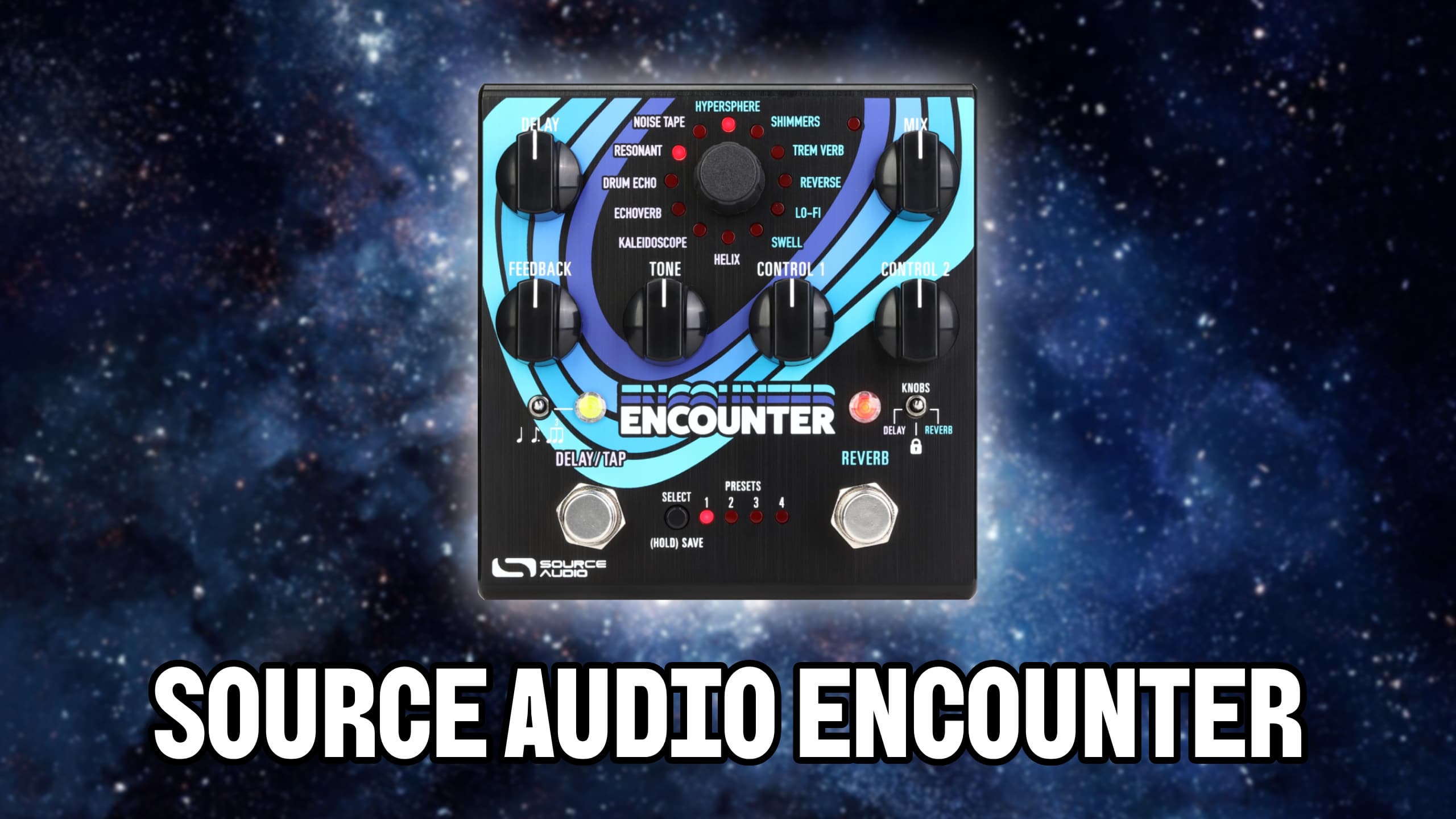
The Source Audio Encounter is a bold reimagining of how delay and reverb can be incorporated into a modern pedalboard. More than a tool for echoes and ambient wash, it’s an immersive sound-design engine that makes you rethink the role of time-based effects in your setup. With truly deep sonic character, dual independent effect paths, full stereo I/O, expansive connectivity, and impressive control using the Neuro App, the aptly named Encounter feels like a glimpse into the future of pedal technology.
CONSTRUCTION AND DESIGN
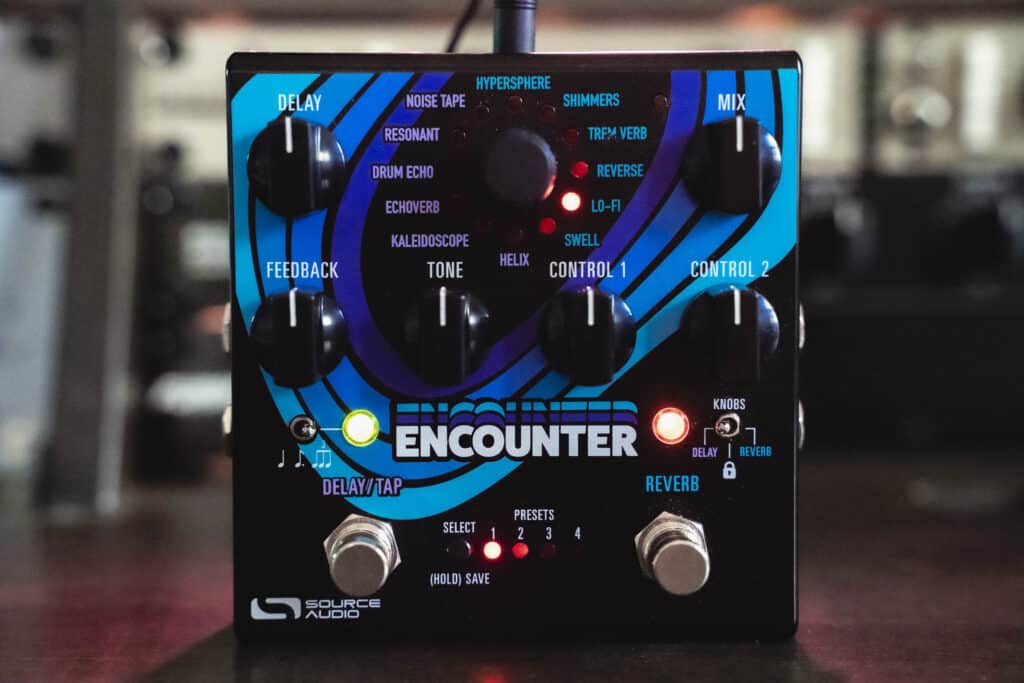
Right out of the box, the Encounter feels robust and thoughtfully engineered. Its brushed aluminum chassis is solid, and equally at home on a roadworn pedalboard, or sitting on a music producer’s studio desk. The footswitches have satisfying tactile response, and everything from the knobs to the input/output jacks exudes durability. There’s a weight to it that speaks to quality, yet the size remains compact enough for crowded pedalboards. The economical construction is impressive considering just how much Encounter can do.
DELAY AND REVERB ENGINES
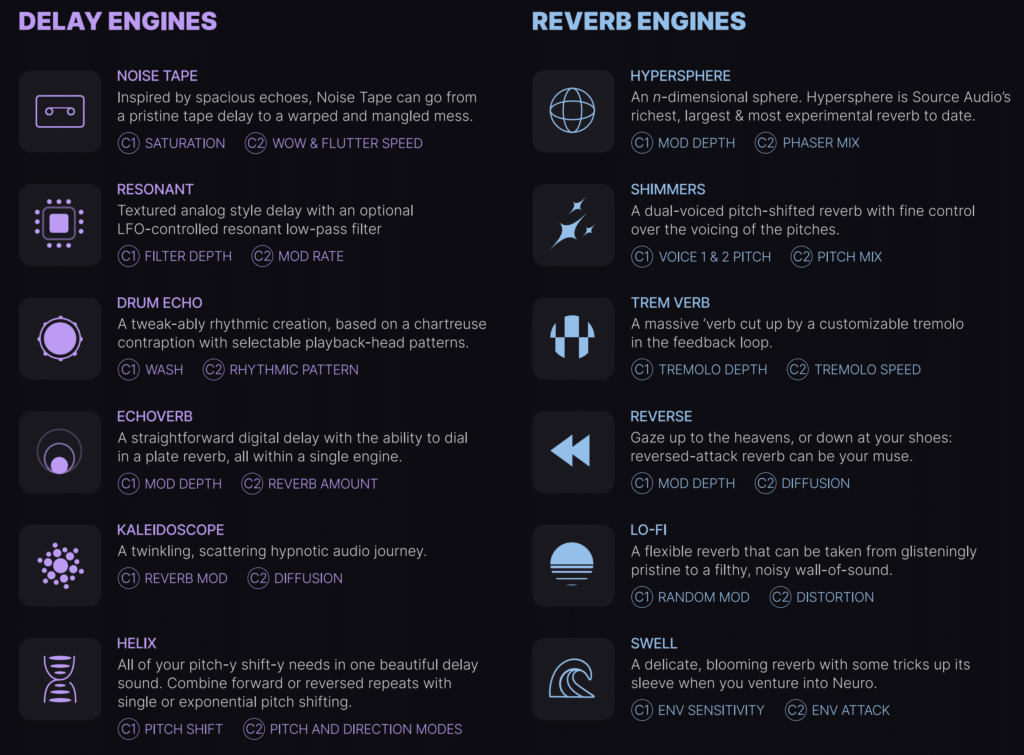
The heart of the Encounter lies in its collection of digital engines. You get six distinct flavors (each) of reverb and delay, which I will cover beneath. And here’s where the pedal really feels like the future: any two engines can run simultaneously — delay + reverb, dual delays, or dual reverbs — and you can route them in series, parallel, or split stereo for astounding complexity.
Noise Tape
The Noise Tape Delay Engine is inspired by the tape section of the classic Roland Space Echo, but it goes beyond simple emulation. At lower settings, it delivers clean, articulate repeats. Push it further and it blooms into a beautifully degraded swirl — complete with modulation, saturation, and timeworn character. It captures that nostalgic tape warmth while offering a wider range of control than the original hardware ever allowed. In all the beneath audio examples, which were created using my vintage Suzuki Omnichord, Version A is DRY, Version B is with the Effect, and Version B is with both Control Knobs turned higher.
Drum Echo
Drum Echo channels the vintage multi-head drum echo units like the Echorec, known for their rhythmic, cascading delay patterns. Eight selectable variations provide distinct rhythmic structures right from the pedal, with even more options available in the Neuro ecosystem. A standout feature is the adjustable “wash,” which lets you dial in anything from tight, percussive patterns to a blooming, reverb-like ambience as the repeats build on themselves. It’s rhythmic, musical, and incredibly inspiring for syncopated playing.
Kaleidoscope
Kaleidoscope is where things turn futuristic. Instead of traditional repeats, it creates a shimmering cascade that splinters across the frequency spectrum. The effect can be subtle and conventional at lower settings, but as you increase the intensity it transforms into a sparkling, harp-like swirl of echoes that feel prismatic and animated. It’s less about echoing your note and more about refracting it.
Resonant
Resonant is a smooth, analog-inspired delay with warm, gently darkening repeats. But it doesn’t stop at vintage homage. This updated version adds a modulating resonant filter inside the feedback path, giving the repeats a living, liquid movement. The result is a delay that feels warm and classic at first touch — then reveals depth and motion as you lean in. It’s buttery, expressive, and surprisingly dynamic.
EchoVerb
EchoVerb blends delay and reverb into a single, elegant engine. It begins as a pristine digital delay, but as you increase the secondary control, a lush plate reverb blooms inside the repeats. The result is a cohesive ambient texture where delay and space are inseparable. It’s a beautifully musical hybrid that makes expansive tones effortless.
Helix
Helix is the most adventurous delay in the lineup. Featuring octave-up, fifth, octave-down, and unison pitch options — plus forward or reverse motion — it creates radiant, harmonically rich echoes that evolve with every repeat. Whether compounding pitch shifts into spiraling textures or keeping them fixed for shimmering harmonic layers, Helix feels expansive and modern. It’s iridescent, creative, and undeniably forward-thinking.
Hypersphere
Moving onto the reverbs, Hypersphere is the most expansive and surreal reverb in the Encounter. Rather than simulating a traditional room or hall, it creates an abstract, boundary-less space where reverberations seem to float without clear reflections. It’s vast, enveloping, and immersive — less like standing in a cathedral and more like drifting in open air. For ambient composers and textural players, it delivers an enormous, almost three-dimensional bloom that feels otherworldly.
Shimmers
Shimmers is a lush, dual-voiced pitch-shifting reverb capable of producing two independent pitch layers above or below your dry signal. Out of the box, it offers musical interval combinations like octaves and fifths, but through deeper editing it becomes a fully customizable harmonic engine. The result is angelic, orchestral, and cinematic — perfect for swelling pads, post-rock crescendos, and ambient soundscapes that feel lifted into the stratosphere.
Trem Verb
Trem Verb fuses tremolo and reverb into a single, expressive engine. The tremolo modulation can pulse through the reverb tail, creating rhythmic movement within a spacious wash. With multiple LFO shapes available and routing flexibility via the Neuro editor, Trem Verb ranges from subtle shimmer and motion to hypnotic, pulsating ambience. It’s both atmospheric and kinetic — a rare combination in reverb design.
Reverse
A staple for psychedelic textures and shoegaze swells, Reverse recreates the classic studio technique of reversing tape through a reverb unit — but does it in real time. The result is that haunting, backwards bloom that rises up before each note. It’s dramatic, emotional, and instantly evocative, offering cinematic tension and dreamlike transitions without requiring studio trickery.
Lo-Fi
Lo-Fi is the antidote to overly polished reverb. This engine introduces grit, distortion, and modulation to create degraded, textured space. It can feel warped, unstable, and beautifully imperfect — ideal for indie, experimental, or synth-leaning players who want atmosphere with character and edge rather than pristine gloss.
Swell
Swell is a foundational ambient tool, using envelope controls to automatically fade in notes and chords for smooth, violin-like textures. It eliminates pick attack and turns simple phrases into evolving pads. With deeper control available in the Neuro ecosystem, you can fine-tune how the swell responds and even isolate it to specific signal paths. The result is organic, blooming ambience that feels expressive and dynamic.
CONTROLS
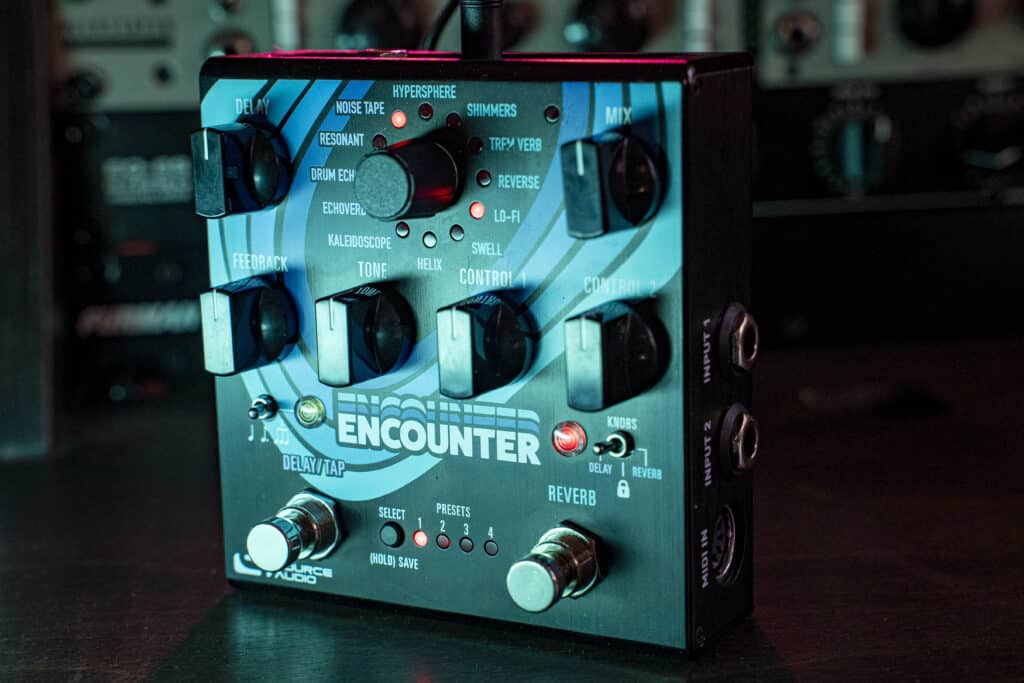
Despite hosting a dozen powerful effect engines, the Encounter’s control layout is surprisingly intuitive. Two dedicated footswitches independently activate delay and reverb, so you’re never fumbling to turn individual effects on or off mid-performance. A “Knobs” selector switch lets you jump between Delay and Reverb control sets, and there’s even a knob lock to protect your settings in live scenarios. The left footswitch doubles as tap tempo for on-the-fly timing adjustments, and subdivision options add rhythmic flair to your repeats. Here is a breakdown of the knobs and what they do:
DELAY Knob
The Delay knob sets the time between repeats when using any of the delay engines. When working with reverb, this same control adjusts the pre-delay — the space between your dry signal and the onset of the reverb tail — allowing you to fine-tune clarity and separation.
MIX Knob
The Mix control blends your dry signal with the effected signal. In standard routing modes, it adjusts the overall wet/dry balance. In Parallel and Split Stereo modes, the Mix knob governs the wet signal level only, while the analog dry-through (ADT) level can be adjusted independently via the secondary control function.
FEEDBACK Knob
Feedback determines how long the effect sustains. In delay engines, it controls the number and intensity of repeats. In reverb engines, it adjusts the decay time of the reverb tail. At higher settings — depending on the engine — the pedal can enter musical self-oscillation, where repeats build in intensity rather than fade, opening the door to expressive, experimental textures.
TONE Knob
The Tone knob shapes the overall brightness or darkness of the repeats or reverb tail. Roll it back for warmer, darker ambience, or increase it for brighter, more present reflections. On certain engines, Tone also serves a secondary, engine-specific function, expanding its creative potential.
CONTROL 1 & CONTROL 2 Knobs
These two knobs are where each engine reveals its personality. Rather than fixed parameters, Control 1 and Control 2 adapt to the selected engine, typically adjusting modulation depth, pitch variation, wash, shimmer intensity, filter behavior, or other defining characteristics. They’re designed to bring out each algorithm’s unique voice without overwhelming the user with menus.
SUBDIVISION Toggle Switch
Used alongside Tap Tempo, this three-way toggle selects the rhythmic division applied to the delay time. Options include quarter notes, dotted eighths, and triplets — making it easy to sync repeats to your performance with musical precision.
KNOBS Toggle Switch
This switch determines whether the physical knobs are currently controlling the Delay or Reverb engine parameters. A center “Lock” position freezes the controls in place, preventing accidental changes — an especially welcome feature for live performance.
ALT VOLUME (Secondary Control)
By holding the ALT button and turning the Mix knob, you access the master output level control, adjusting the overall volume of the pedal (wet and dry combined). In Parallel and Split modes, this function instead adjusts the dry signal level independently — offering precise balance in more advanced routing setups.
PRESET Button
The Preset button makes storing and recalling sounds simple. Press to cycle through preset slots. Press and hold to save your current configuration. LED feedback clearly indicates saved changes or unsaved edits, making preset management intuitive and performance-ready.
USING THE NEURO APP
One of the standout futuristic features of the Encounter is its integration with Source Audio’s Neuro app ecosystem. Through USB, you can dive into far deeper parameter control than the pedal’s surface knobs allow, unlocking instant editing, preset management, and sharing across devices. This hybrid approach, where physical and digital worlds meet so seamlessly, really emphasizes how Source Audio is pushing pedal UX forward.
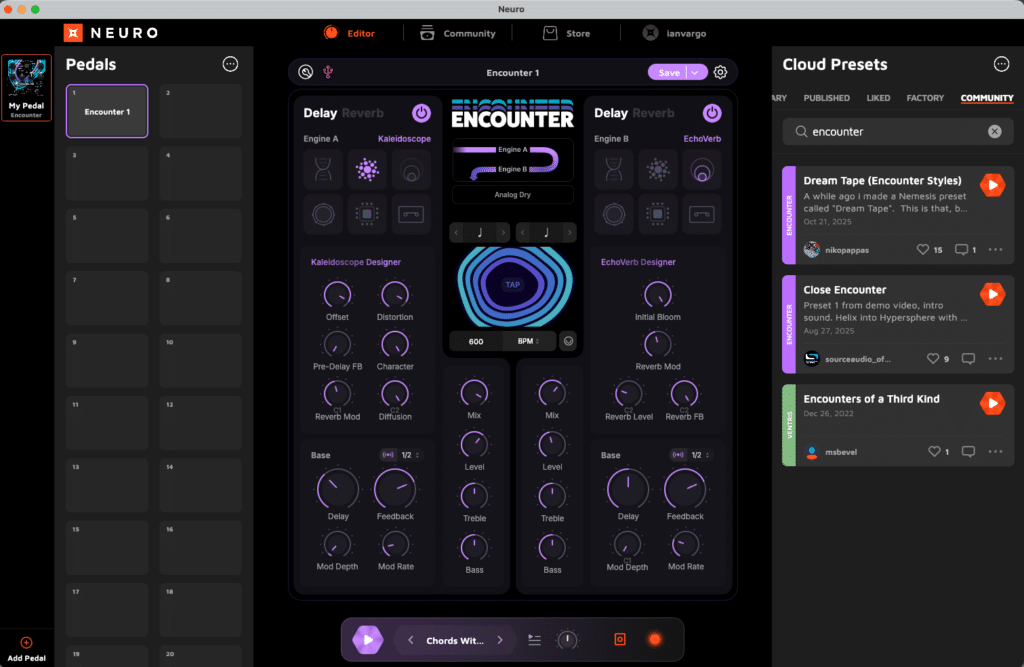
The Encounter Pedal is a stunner on its own, but paired with the Neuro App, which stores your source audio pedals, allows access to user presets, and can even change settings instantly seals the deal, making this one of the most flexible modern pedals.
SOUND QUALITY AND APPLICATIONS
In use, this pedal sounds nothing short of spectacular. Clean signals remain pristine through the analog dry-through path, and the digital engines are lush without ever feeling sterile. Whether you’re crafting huge ambient washes, rhythmic delays, otherworldly textures, a subtle (or wild) spatial shimmer, the sonic range is astonishing. The stereo operation opens up gorgeous panoramic soundscapes, and dynamic tweakability makes every performance feel fresh and inspiring.
Obviously guitar players are going to have a blast with Encounter, but I feel as if this pedal can be utilized for far more applications than just a six string. I put it through its paces on synthesizer, Omnichord, and even on vocals, which I routed out of my DAW. In the right hands, Encounter can serve as a full fledged studio hardware unit.
WHO IS THE SOURCE AUDIO ENCOUNTER FOR?
The Encounter is ideal for adventurous musicians and sound designers who want more than just basic time-based effects, and for users who crave a greater degree of control than provided by traditional stompboxes. If you crave deep modulation possibilities, expansive ambient tones, and seamless hardware-software interplay, this pedal delivers. It’s perfect for guitarists pushing into cinematic and textured terrains, producers adding atmospheric depth to tracks, and anyone who enjoys exploring sonic frontiers. Casual stompbox users will still find inspiration here, but this unit truly shines in creative and experimental contexts.
If you are a producer looking for an impressive collection of time-based effects to use during tracking and mixing, The Encounter is as impressive as any reverb and delay unit I’ve ever used, especially once you learn the Neuro app.
SUMMARY
In a crowded field of delay and reverb pedals, the Source Audio Encounter stands out as a visionary device. It blends impeccable build quality with surprisingly intuitive control, rich and diverse effect engines, and a futuristic integration with the Neuro app that expands its creative reach enormously. Whether you’re shaping vast reverberant spaces or dialing in nuanced rhythmic echoes, this pedal feels like a next-generation tool — a ready-made bridge between traditional stompbox use and modern digital sound design.
ABOUT THE AUTHOR
Ian Vargo is a Music Producer, Mix & Mastering Engineer, and Multi-Instrumentalist whose work has been heard on broadcast television, nationally televised ad campaigns, award-winning films, and viral web content amassing over 30 million views. His credits include projects for Disney | ABC, Intel, MSNBC, Airbnb, EA Games, and many more.
With over 20 years of experience in the studio, Ian has contributed to major label releases (Capitol, EMI, Fueled by Ramen, Universal, Interscope, Hollywood Records) as well as acclaimed independent projects. His passion lies in helping artists translate their creative vision into professional, release-ready recordings that stand out in today’s music landscape.
Interested in working together? Reach out at ianvargo@gmail.com if you need mixing or mastering for your next project.