ChatDSP is a new offering from Dillon Bastan that allows users to create virtual instruments, audio effects, and MIDI effects Max for Live devices with text prompts using LLM (Large Language Models). It requires an account with either OpenAI or Anthropic to function and offers several options for AI Agent models and effort levels. It can generate devices with up to 48 parameters, and code can be exported for use in other software like the standalone version of Max/MSP or as C++ for use in hardware, web apps, etc.
I took the device for a spin and experimented with the three main device generators: Chat DSP Synth, ChatDSP FX, and ChatDSP MIDI. Below are the results:
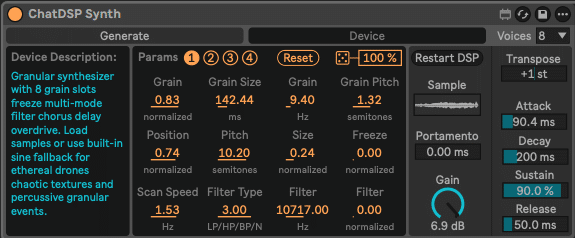
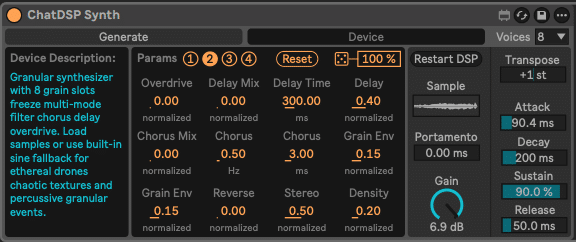
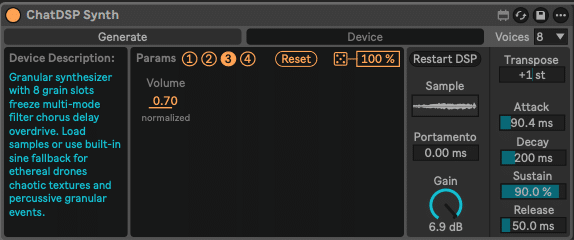
ChatDSP Synth
- AI Agent: Anthropic
- Model: Claude OPUS-4-6
- Level: xHigh
- Thinking time 4:34
- Cost: $.50
Prompt
Create an experimental synthesizer that uses granular synthesis. The synth should create organic, evolving, and unexpected textures. Include common granular synthesis parameters, unusual performance controls, and randomization options. Include some basic onboard processing effects like delay, chorus, and overdrive. Include amplitude envelope controls. The device should be capable of ethereal evolving drones, chaotic textures, and percussive events. Include a freeze function. Include a way to add custom sound files to granularize. The device should be polyphonic with at least 8 voices. Include a multi-mode filter section.
ChatDSP FX
- AI Agent: Anthropic
- Model: Claude OPUS-4-6
- Level: xHigh
- Thinking time 3:09
- Cost: $.36
Prompt
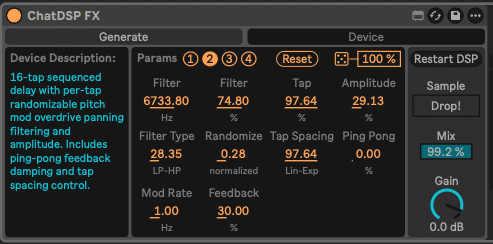
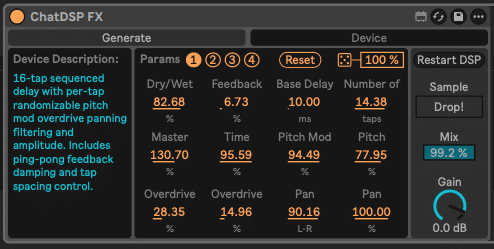
Create a delay effect that has a built-in step sequencer, which has up to 16 taps. Include the ability to change the pitch, overdrive FX, pan, filtering, and amplitude for each tap. The sequencer should have common delay controls and a way to randomize settings based on an independent percentage for each parameter. It should have a graphic interface that is user-friendly.
This process failed to meet many of my requests, and not all parameters functioned as expected. That said, I had a little fun messing with this vocal sample.
ChatDSP MIDI Effect 1
- AI Agent: Anthropic
- Model: Claude OPUS-4-6
- Level: xHigh
- Thinking time 4:02
- Thinking time for revision 3:05
- Cost: $.93
Prompt
Create a MIDI that can transpose incoming MIDI events using microtonal tunings. Include a drop down menu with various scale choices including a variety of EDO systems. Include a built-in arpeggiator with standard controls that will arpeggiate incoming chords and adjust all pitches to the selected scale and tonic. Add custom tuning controls and a way to export the tuning file that could be read by other devices.
Demo driving a patch in the Thorn synth. It didn’t work at all at first. This is the result of one revision. The agent failed at satisfying several of my requests and I could have continued with more revisions, but I decided to move on for the purposes of this article
ChatDSP MIDI Effect 2
For this last demo, I tried using lower-level models and thinking, which turned out to be much faster and cheaper.
- AI Agent: Anthropic
- Model: Claude HAIKU 4-5
- Level: low
- Thinking time: 0:11
- Thinking time for revision :29
- Thinking time for revision :15
- Thinking time for revision :12
- Thinking time for revision :20
- Thinking time for revision :14
- Cost: $.15
Prompt
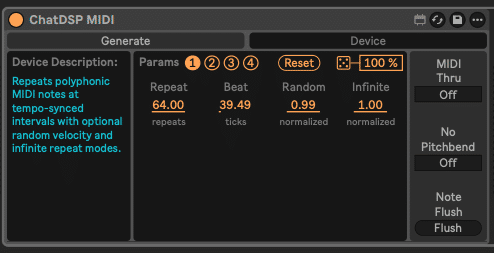
Create a MIDI effect that takes an input note or chord and repeats it multiple times.
Prompt Edit:
Increase maximum repeats to 64 and use an integer control, not a float. Add a control for tempo-synced repeat times.
Prompt Edit:
Add control for beat divisions instead of ticks with the smallest division 1/64th note and make the longest division a whole note.
Prompt Edit:
Add control for random velocity on each repeat.
Prompt Edit:
Make the device polyphonic.
Prompt Edit:
Add control for infinite repeats as long as notes are on.
For the demo below, I drove the Thorn synth from Dmitry Sches.
CONCLUSIONS
The developer bills this as experimental software, and that it is. The implementation by Bastan is well-conceived, and the idea of generating an instrument or effect from a text prompt is a fascinating one. Of my four admittedly rudimentary experiments, the synth patch was the most successful and perhaps usable. That said, I am well aware that the results of AI Agents typically require significant tweaking beyond the first attempted solution, so I can see there is definitely potential here. The more challenging prompts with higher-level thinking and models took longer and were more expensive, as you might expect. It may be that more success is possible with simpler prompts focused on a few tasks, followed by thoughtful tweaking using the Prompt Edit feature.
Kudos to Dillon Bastan for taking this on, and I’d like to see more from him in this direction. All of his devices have the touch of an artist, which sets his catalogue apart from typical commercial product development.
ABOUT AI AND MUSIC
Producers, engineers, composers, and musicians need to come to terms with AI in one way or another. The exponential progress that has occurred in this area has outpaced laws and educational models that have stagnated for years. Turning a blind eye or retreating to the comfort of old school thinking is short-sighted and self-defeating. What is needed is more collaboration amongst developers, artists, engineers, producers, and educators. The laws protecting intellectual property need to be completely overhauled to reflect the current state of technology and designed in a way that maintains flexibility and responsiveness to the accelerated pace of development. I realize this is easier said than done, given the glacial rate at which academic institutions and our legal system tend to move.
There are certainly negative components to the proliferation of this technology. The flooding of streaming services with banal AI-generated content is diluting the royalty pool for human-made work. The legal battle continues regarding the use of copyrighted material for training AI models. It is unclear whether deals made between companies like Warner Music Group and Suno will protect artists or simply go further to line the pockets of the major labels and streaming services, as has historically been the case.
Text prompt-based programming is still in its nascency in terms of the possibilities and accessibility to those without formal training or coding experience. Tweaking code and certain implementations remain barriers for non-coders, but that will be resolved in the near future. Whether this will make traditional software developers obsolete depends on their ability to adapt to the new paradigm. New career paths are emerging every day, and both Anthropic and OpenAI are competing to get their systems embedded into academia to train the next generation.
The development of AI is undoubtedly the most substantial technological breakthrough during my lifetime. It remains to be seen how those born today will view the pre-AI period. Concerns about the use of water and electrical resources are real and need to be addressed. Laws need to be written to curtail corporate avarice and protect creators. There is certainly no shortage of AI slop being produced, but I would argue that humans are equally capable of producing slop; it just takes longer.
If the creative community can resist the need to arbitrarily bellyache about all things AI, perhaps we can move forward and instead start to envision how to reap its benefits while mitigating any potential negative effects. It is an exciting time to be an artist, and this technology offers the means to channel our creative energy in new and mysterious ways.
EXTRAS
Want to win a free license to Kontakt 8? Be one of the first 1000 people to FOLLOW WAVEINFORMER ON INSTAGRAM to be automatically entered to win one of three full-version Kontakt 8 licenses! Read more.
Assess your knowledge of essential audio concepts using our growing catalog of online Quizzes.
Explore more content available to Subscribers, Academic, and Pro Members on the Member Resources page.
Not a Member yet? Check the Member Benefits page for details. There are FREE, paid, and educational options