KPOP DEMON HUNTERS GOLDEN MASTERING ANALYSIS OVERVIEW
In this article, I will be providing an in-depth mastering analysis of “Golden”, the hit song from KPop Demon Hunters. As a parent of two children, I’ve found it hard to go more than a few days without hearing Golden, from the Netflix animated film. Since the movie’s release, the song has surged in popularity—dominating playlists, earning critical recognition, and even receiving Grammy nominations, including Song of the Year. The movie itself blends high-energy action, stylized visuals, and a music-driven narrative, creating the perfect backdrop for a song engineered to hit hard both emotionally and sonically. Beneath, we’ll have a critical look at the technical specs for the master of “Golden”, which was mixed by Curtis Douglas and mastered by Dave Kutch. I would like to clarify before moving forward that how something sounds is, of course, more important than technical mastering specifications.
I’ve listened to this song (a lot) out of my home tv speakers, in my car, and from an Alexa, which resides in our kitchen. None of the aforementioned systems are hi-fi by any means, so I was excited to analyze it in my studio on better monitors. The song always sounds powerful, clear, exciting, and quite dynamic, so part of me expected it to have been somewhat conservatively mastered.
METHODOLOGY
I purchased “Golden” from Qobuz, which allows you to download in a variety of formats including .flac, .wav, .aiff, and more. I downloaded a 24-bit/48 kHz .wav file and loaded it into iZotope RX Advanced and then a Pro Tools session at the same bit depth and sample rate for further analysis. Immediately I could tell from the waveform that I was mistaken in assuming that the song was mastered less competitively than other pop songs that came out in 2025. There are plenty of dynamics between the verses and choruses, but when the choruses hit, they hit hard.
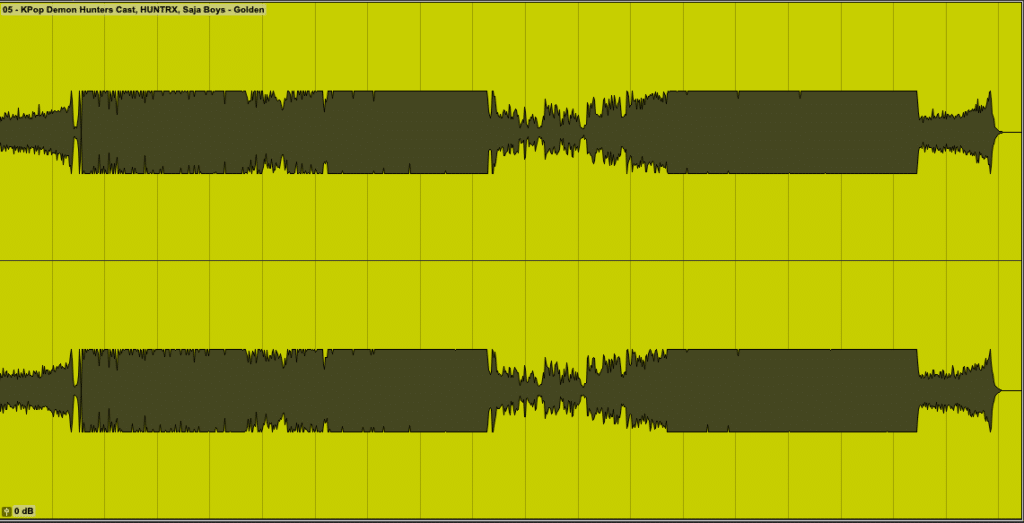
The Waveform of “Golden”, which highlights the song’s dynamic production, and heavy hitting choruses.
Here are some of the the Waveform Statistics (full breakdown beneath), as provided by iZotope RX Advanced:
True Peak Level
L: +1.62 dB
R: +1.24 dB
Integrated Loudness
-7.2 LUFS
Loudness Range (LRA)
10.8 LU
It’s somewhat striking that the True Peak Level for “Golden” is well above zero, with the left registering at +1.62 dB, and the right at +1.24 dB. We’ve seen this trend of exceeding full scale in modern mastering, and it somewhat explains how the song ends up sitting at -7.2 LUFS. The sample peak level sits at -0.2 dB, suggesting that during mastering, the ceiling of a limiter was set to -0.2 dB, and pushed into hard, without any ‘True Peak” setting being engaged. Many mastering engineers also like clipping high quality A/D converters when mastering. I can’t say for certain that this was done here, but I wouldn’t be surprised. Regardless, it’s clear Dave Kutch delivered the kind of excellent work you’d expect from one of the industry’s most celebrated veterans.
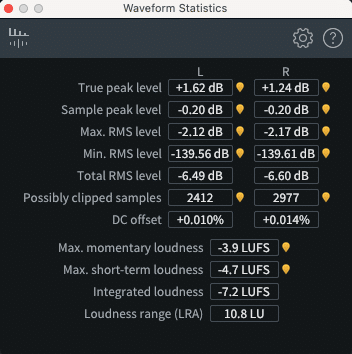
A full look at the waveform statistics as provided by iZotope RX Advanced
GOLDEN IS LOUD, BUT HOW DOES IT SOUND?
Sometimes songs that are aggressively limited, clipped, compressed etc. suffer from a lack of punch in the drums, deficient bass response, harshness, and an overall crowdedness to the mix. “Golden” does not suffer from these issues. The kick drum that anchors the chorus is deep and punchy. The vocals, which sound plenty processed (intentionally so), are clear without ever seeming harsh, and the rest of the arrangement never crowds these foundational elements of the song.
This is a testament to the way the song was constructed. The arrangement, performances, sound design, and mix were all executed with the intention of creating a hard-hitting, vocal-forward, electronic pop song. It would be a challenge, if not impossible, to make an acoustic, more delicately performed song reach these levels while still feeling natural. Much has been made of the importance of loudness, and hitting LUFS targets, but the most essential duty of a mixing and mastering engineer (the two roles that have the most control over loudness) is to serve the song.
ACHIEVING LOUDNESS
When mixing, I generally push a song as hard as it needs to go. I was taught to make the song sound as finished as possible, and that’s what I strive for. If the mastering engineer receives my mix and has to do little to no processing, I have succeeded. Through gain staging, my multi-buss mixing template, and processing on the mix buss that includes compression, clipping, and limiting (both hardware and software) I can get most mixes to the -10 or -9 LUFS range with relative ease. If a mastering engineer requests a print with more conservative processing, I am happy to deliver.
Mastering is a different skillset than mixing, and involves much more than signal processing, but in terms of delivering competitively loud masters, most of the tools are the same. I use EQ, (mostly upwards) compression, clipping, limiting, and some other specialized tools to go as hard as the client wants, while still serving the song. I find that going far beyond -8 LUFS usually compromises the mix, but for songs like “Golden” with near-constant 4-on-the-floor kicks and full arrangements, or a rock band with consistent distorted electric guitar energy and pounding drums, it’s much easier to achieve louder masters. Check out this roundup of my favorite mastering plugins.
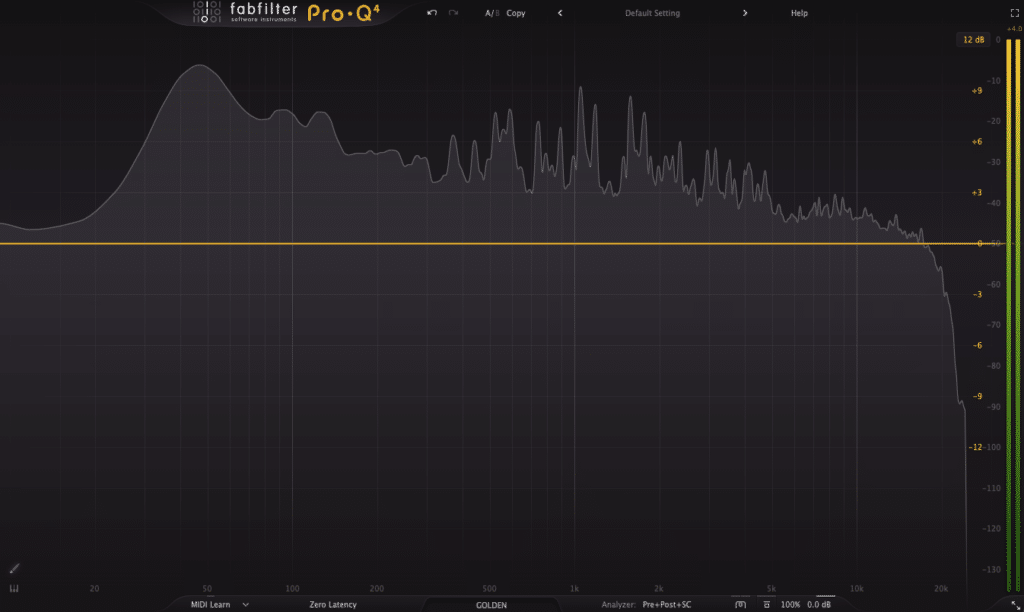
A screenshot of the EQ Curve of the Chorus of “Golden”, which shows a lot of energy just beneath 50Hz, due to the kick drum.
I also downloaded high quality versions from Qubuz of the instrumental and acapella of “Golden” for a closer look at how the song was constructed. I found there to be significantly more low end in the lead vocals than is typical for electronic-based pop music. The vocal production, which includes tightly edited stacks of vocals, as well as a lot of nifty processing, results in an acapella that is very powerful and energetic. Combine this with the densely packed instrumental, which again relies heavily on a constant kick drum that contains plenty of high and low information; it’s not a surprise the final master has so much sustained energy
I see a lot of criticism online about how the loudness war has ruined dynamics in music, and therefore negatively affected the sound quality of modern productions. I also see engineers suggesting that ‘the loudness war is over’ because streaming services implement loudness normalization, which automatically adjusts song levels depending on the platform’s target (listed below). I suggest any aspiring engineer to not treat this advice as gospel, as commercial music generally exists within that aforementioned -10 to -7 LUFS range. You don’t need to make every master that loud, but if you don’t at least know how, you probably won’t have a career in commercial/pop music production.
TARGET INTEGRATED LUFS BY PLATFORM
Spotify: –14 LUFS
Apple Music: –16 LUFS
YouTube / YouTube Music: –14 LUFS
Amazon Music: –13 to –14 LUFS
Tidal (and many others): –14 LUFS
KPOP DEMON HUNTERS GOLDEN MASTERING ANALYSIS SUMMARY
“Golden” achieves its extremely competitive loudness not solely because it was mastered above 0 dBFS, but because loudness was baked into the record from the very beginning. The songwriting, arrangement, and production are tightly constructed to support density and impact, with sound design choices that minimize unnecessary dynamic swings and keep energy consistently high. Careful mixing further reinforces this, balancing transients, managing low-end buildup, and shaping tonal density so the limiter has less work to do at the mastering stage. The mastering then pushes the track to its final loudness target, but it succeeds because every step before it was intentional. In this case, the loud master is the result of a well-executed creative and technical process, not a single aggressive decision at the end of the chain.
ADDITIONAL DOCUMENTATION
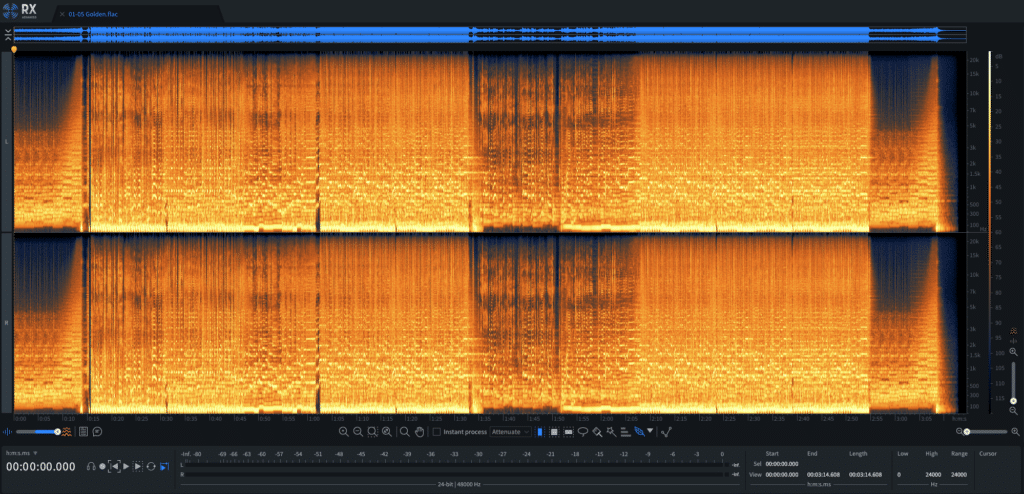
The iZotope RX Spectrogram of “Golden”
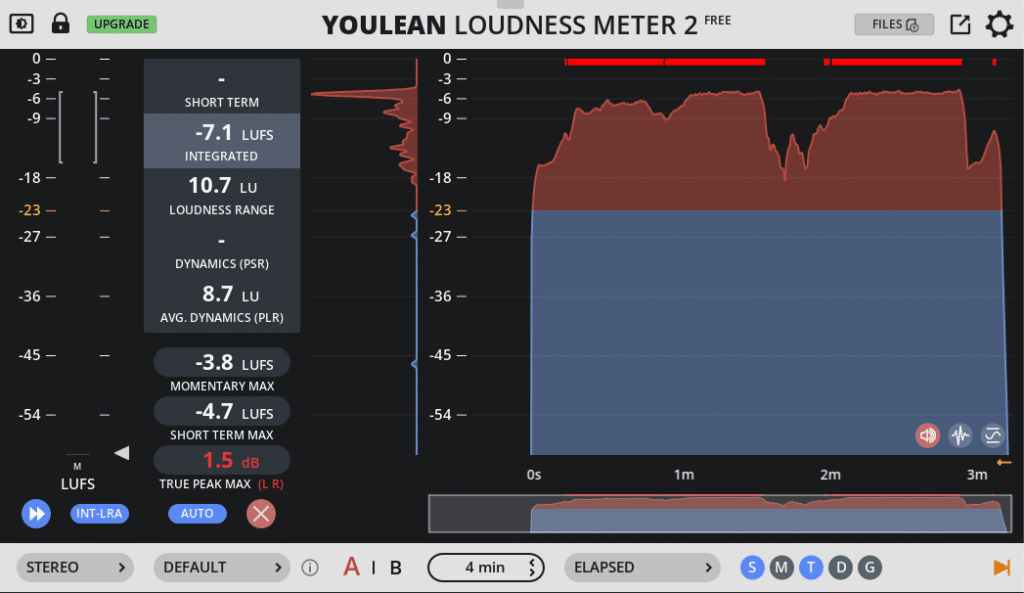
YouLean Loudness Meter, a great free utility, which admittedly gave a slightly different readout (0.1 dB)
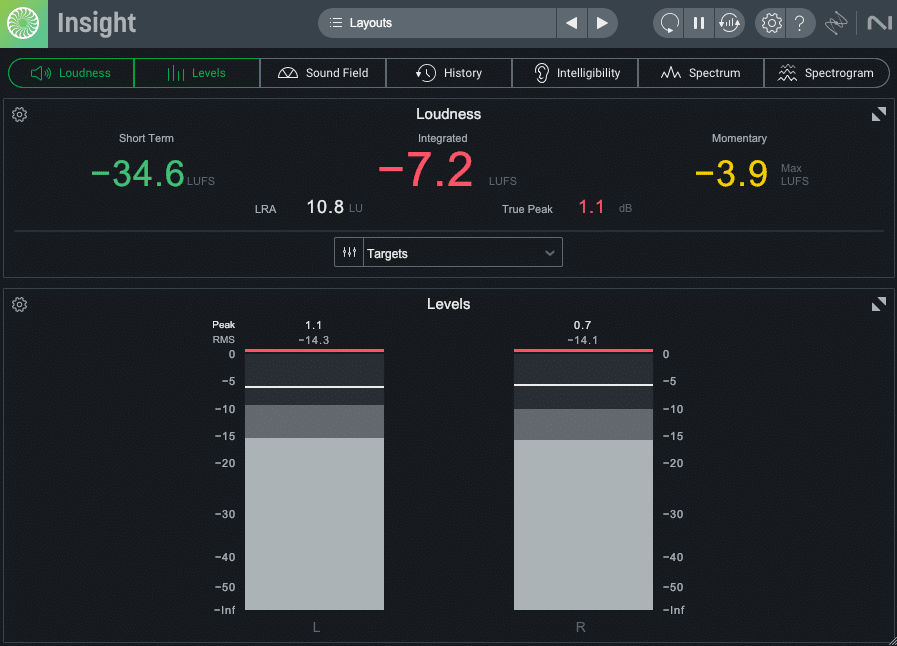
iZotope INSIGHT 2
LIST OF CREDITS ON GOLDEN
Ejae – vocals
Audrey Nuna – vocals
Rei Ami – vocals
Ido – producer
24 – producer
Teddy – producer
Ian Eisendrath – producer, strings conducting, vocals arranging
Derik Lee – vocals recording
Noah Hubbell – vocals recording
Andy Dudman – strings recording
Rob Mathes – strings arranging
Hillary Skewes – strings contracting
Oren Yaacoby – music editing
Sandra Park – vocals contracting
Mike Casteel – music preparation
Jill Streater – music preparation
Josh Fried – music associate
Curtis Douglas – mix engineering
Dave Kutch – mastering
ABOUT THE AUTHOR
Ian Vargo is a Music Producer, Mix & Mastering Engineer, and Multi-Instrumentalist whose work has been heard on broadcast television, nationally televised ad campaigns, award-winning films, and viral web content amassing over 30 million views. His credits include projects for Disney | ABC, Intel, MSNBC, Airbnb, EA Games, and many more.
With over 20 years of experience in the studio, Ian has contributed to major label releases (Capitol, EMI, Fueled by Ramen, Universal, Interscope, Hollywood Records) as well as acclaimed independent projects. His passion lies in helping artists translate their creative vision into professional, release-ready recordings that stand out in today’s music landscape.
Interested in working together? Reach out at ianvargo@gmail.comif you need mixing or mastering for your next project.