HEARS Perfection is a new plugin from Brainworx that is intended to compensate for each individual’s ability, or lack of ability, to hear specific frequency ranges. It is a brilliant idea, and I’m surprised nothing like it has been offered before. First, a brief discussion of the horrendous notion of hearing loss that no one wants to consider.
CAUSES OF HEARING LOSS
There are several causes of hearing loss you should be aware of:
Age-related hearing loss, also known as Presbycusis, is something most of us will experience at some point. “About one in three people between the ages of 65 and 74 has hearing loss.” (source)
This typically occurs in our ability to hear higher frequencies above 12kHz or so. But the effect can be even more dramatic, affecting lower frequencies as well. Have a look at the disturbing chart below. Aside from age, there are also extreme differences between women and men (source).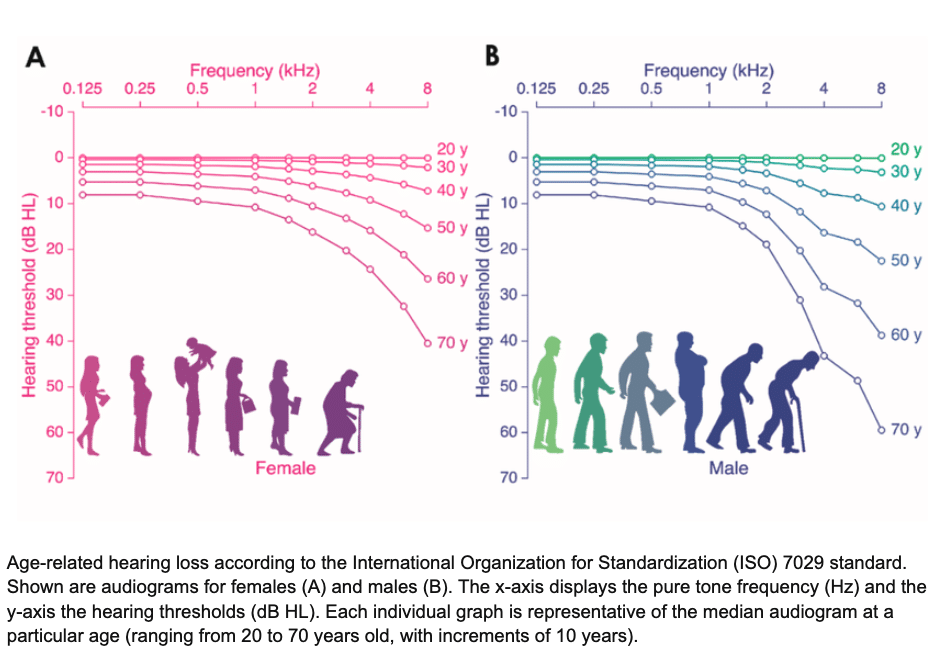
Disease-related hearing loss, like that from otosclerosis and Ménièr’s Disease can affect balance as well as hearing (source).
Medication-induced hearing loss can be caused by certain antibiotics, large amounts of aspirin, or chemotherapy drugs (source).
Permanent hearing threshold shifts can be caused by acoustic trauma from extreme loud noises like gunshots or other noise bursts.
Head injuries can result in permanent hearing loss.
Exposure to loud, sustained sound can result in permanent hearing loss. OSHA (Occupational Safety and Health Administration) has published acceptable levels and timeframes of exposure to noise beyond which you risk permanent hearing loss (source):
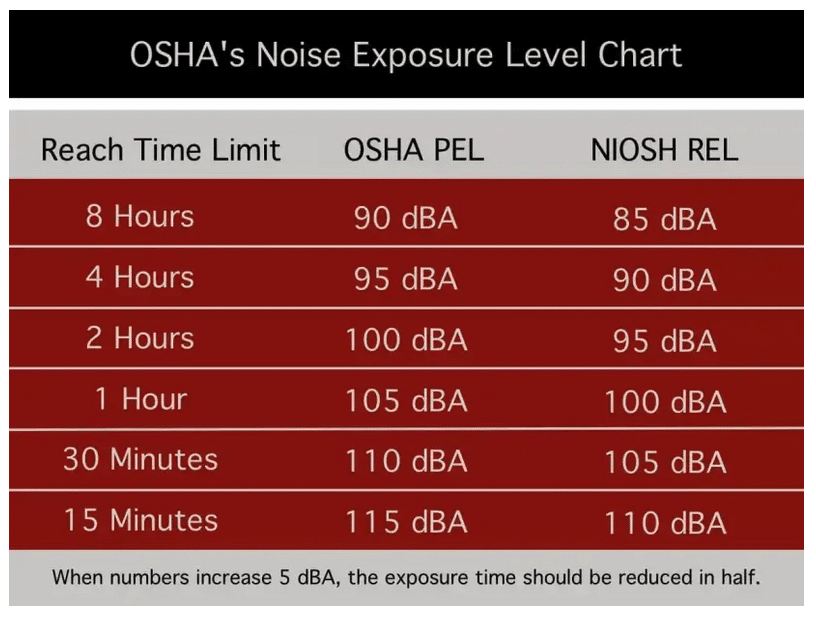
Note that as the level increases by 5dBA, the acceptable exposure time is reduced by half. This is especially relevant to audio engineers who might spend hours on a particular mix without breaks. Not only is this dangerous, but you will also lose perspective and the ability to make good decisions. This is why many engineers choose to work at a level of around 75 to 80dBSPL. Not only is this safer, but the level is a good compromise as it relates to the Fletcher-Munson Equal loudness contours, which describe how level affects our ability to hear a balanced spectrum.
CAN HEARING LOSS BE REVERSED?
To date, hearing loss cannot be reversed biologically. Hearing aids can be used to boost levels of certain frequencies or levels in general, but the result will not be the same as normal hearing. In some cases, hearing aids use “frequency lowering” technology, which transposes high-frequency content to lower octaves when simply increasing the level of high frequencies is not adequate. Of course, in terms of the critical listening needs of an engineer, this would not be appropriate.
It should be noted that typical age-based hearing loss is not abrupt, but gradual. You may still have the ability to hear higher frequencies, but they could be perceived at a lower level than someone with better hearing. And that level will decrease over time until you don’t hear them at all.
If this all sounds depressing, that’s because it is. But it should serve as a reminder that protecting your ears while your hearing is good is crucial. Reducing your exposure to high levels and using musicians’ earplugs are good practices. Have a look at my review of musicians’ plugs that attempt to reduce levels while retaining frequency balance: 6 Earplugs for Musicians, Engineers and Concert-Goers
IS YOUR CAREER OVER IF YOU HAVE HEARING LOSS?
No! Happily, much of the age-based hearing loss people experience occurs most dramatically in the higher frequencies, which typically has less overall content than the mid-range or low end in musical contexts. But it can make a significant impact on the decisions engineers need to make in crafting the frequency balance of a mix.
Finally, one developer has addressed this issue with a simple corrective approach in the form of a plugin: Brainworx’s HEARS Perfection.
HOW HEARS PERFECTION WORKS
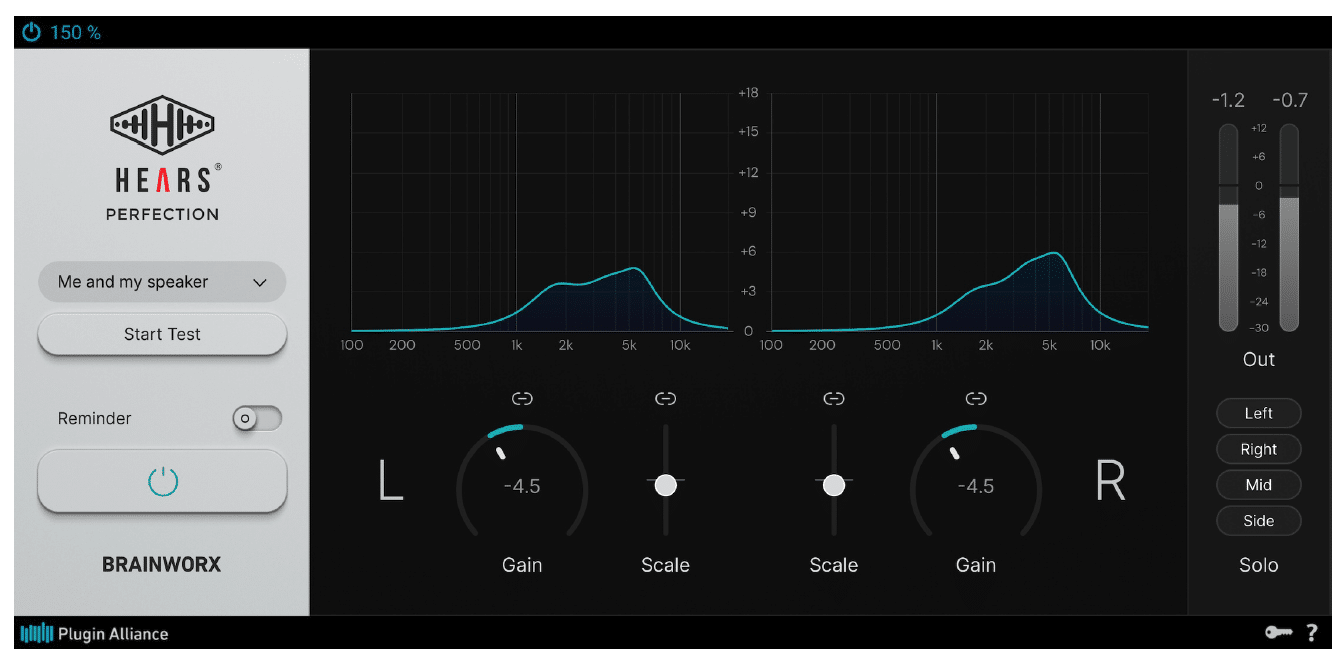
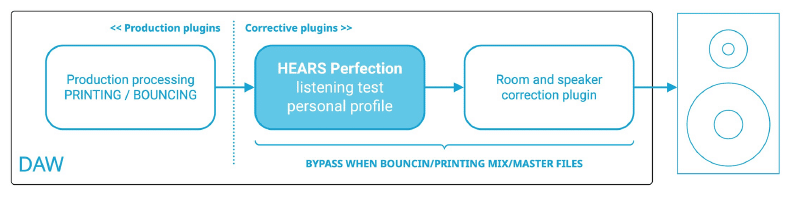
The plugin is instantiated near the end of your signal chain, but before any room correction software, such as Sonarworks. You create an individual hearing profile using a simple test built into the software. This creates a corrective EQ curve that is applied to the mix as you work, correcting for any deficiencies you may have in particular frequency ranges by boosting those ranges proportionally. It also adjusts for differences between your right and left ears, which are common.
Once the test is completed and a curve is generated, the controls are few and can generally be left as is unless you want to tweak the aggressiveness of the effect. One well-conceived feature is the Reminder switch. This emits a periodic noise burst to remind you to bypass the plugin before bouncing. As with corrective EQ software, this plugin is intended to be used only during mixing, or your bounced track will be useless in any other context.
ARE THERE OTHER METHODS OF HEARING COMPENSATION?
Using reference tracks is a tried-and-true method of comparing a professional mix to a work in progress. This is appropriate and effective even if you don’t have hearing issues. Match EQs can be used to conform one mix to the spectral profile of another. Metering and analysis plugins can provide objective measurements that are useful for visualizing and quantifying the sound.
But none of these methods is designed to aurally compensate for the attenuation you may be experiencing. HEARS Perfection attempts to do just that by generating and applying a custom EQ profile as you mix.
VIDEO WALKTHROUGH
CONCLUSIONS
The effect of using HEARS Perfection may be subtle or extreme based on your situation, but just being able to visualize and hear the effect of your particular profile will be informative and allow you to make decisions that better align with average human hearing capabilities with a higher degree of confidence. I highly recommend giving this plug a try.
EXTRAS
Want to win a free license to Kontakt 8? Be one of the first 1000 people to FOLLOW WAVEINFORMER ON INSTAGRAM to be automatically entered to win one of three full-version Kontakt 8 licenses! Read more.
Assess your knowledge of essential audio concepts using our growing catalog of online Quizzes.
Explore more content available to Subscribers, Academic, and Pro Members on the Member Resources page.
Not a Member yet? Check the Member Benefits page for details. There are FREE, paid, and educational options.