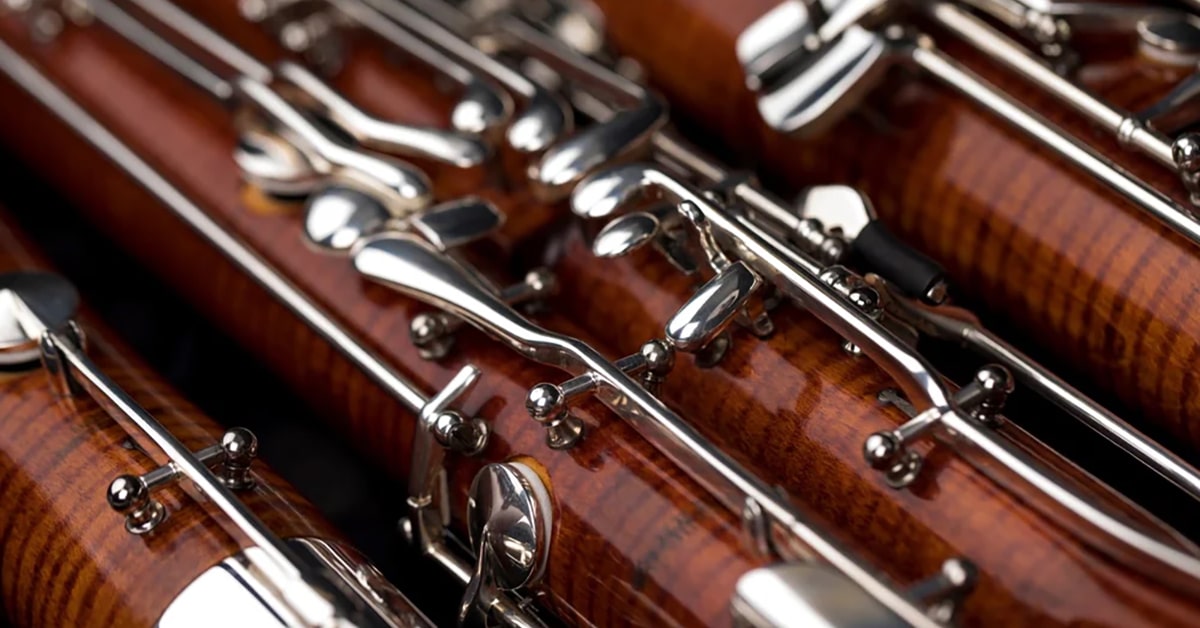
In this review, I will be looking at the various libraries of sampled woodwind instruments available from Orchestral Tools. Each library is available as a standalone product, or as part of a larger bundle. Instruments can also be purchased individually.
WHAT ARE WOODWINDS AND HOW TO USE THEM?
The woodwind choir is one of the 4 ensembles that make up the symphony orchestra, the others being strings, brass, and percussion. They can provide melody, harmony, and color to the orchestra, but are equally at home in smaller ensembles and solo situations. Woodwind instruments can be divided into 4 major families:
- Flutes (flute, piccolo, alto flute, bass flute)
- Oboes (oboe, English horn, bassoon, contrabassoon)
- Clarinets (clarinet, bass clarinet, contrabass clarinet)
- Saxophones (soprano, alto, tenor, baritone)
With the exception of the saxophones, all of these instruments were originally made of wood, although in modern times they are often constructed of metal or even plastic. The term woodwinds reflects their original construction. Saxophones are actually made of brass, but are typically grouped with woodwinds because of their many other similarities.
Aside from the flutes, which activate the air column directly, all woodwinds use a reed mechanism to generate vibrations and create sound. Clarinets and saxophones utilize a single reed, while oboes use a double reed system.
The use of woodwind instruments is certainly not limited to classical music. Consider this example from the Beach Boys album Pet Sounds:
Notice the use of the flute and English horn to double melody, create a counter melody and fill out the harmony.
Since its invention in the 1840’s, the saxophone has been used extensively across many genres including jazz, rock and roll, blues, and classical. Check out this virtuosic example from John Coltrane:
For a more detailed background on woodwind instruments, see The Study of Orchestration by Samuel Adler or Instrumentation and Orchestration by Alfred Blatter.
BERLIN WOODWINDS
For anyone looking to add orchestral woodwinds to their library of virtual instruments, the flagship Berlin Woodwinds collection provides an excellent selection, including a multitude of flutes, oboes, and clarinets. All of the instruments in the Berlin Orchestra collection are recorded on the Teldex scoring stage in Berlin, Germany. Available mic positions include spot mics, AB, ORTF, TREE, and SUR. They can be mixed to taste, allowing for great control over the wet/dry balance.
Below is a detailed look at what instruments are included and some examples:
FLUTES
- Flute 1
- Flute 2
- Flute 3
- Piccolo Flute
- Alto Flute
Flutes 1, 2, and 3 are each distinct-sounding instruments, varying in tone color from the more mellow flute 1 to the brighter flute 3. Each comes with a large variety of articulations, including sustains, staccato, portato, trills, and sforzando. Listen to the differences between the 3 flutes below. The passage is taken from the previously shared Beach Boys tune I’m Waiting For the Day by Brian Wilson (1966).
For a complete listing of all available articulations for each instrument, visit the product page.
Each articulation can be loaded into the Orchestral Tools’ SINEplayer plugin and custom-mapped using key switches, midi channels, cc values, or program changes. Switching between appropriate articulations is critical for attaining a realistic sound, and there are plenty of options here to do just that. The examples below incorporate many of the available articulations, including staccato, staccato short, sustains, portato long, portato short, and playable runs.
The flute passage below is taken from Density 21.5 by Edgard Varese (1936).
The alto flute is a larger flute, deeper in tone, and able to reach down to the G below middle C. The C Flute, by comparison, only reaches down to middle C. The alto flute is played with the same fingerings as a C flute, but sounds a perfect 4th lower.
While the alto flute extends the flute family range downward, the piccolo extends it upwards by an octave. Below are examples of the piccolo and alto flute provided as part of the Berlin Woodwinds collection, each coming with a nice complement of articulations.
The low range of the alto flute, from Ameriques by Edgard Varese (1922):
The upper range of the piccolo:
CLARINETS
- Clarinet 1
- Clarinet 2
Two separately sampled Bb clarinets, ranging just over 3 octaves from the D below middle C up to F6 are provided in the Berlin Woodwinds bundle. There’s a large selection of articulations to choose from here. Sustains with various attacks and dynamics, staccato, short and long, marcato, portato, trills, and repetitions are all present. The “playable runs” articulation, which is also included with the flutes and oboes, is a great feature for blending fast runs of notes in a way that is clear and realistic-sounding. Below is an example of clarinet 1, taken from Amour: Sei wieder fröhlich by Karlheinz Stockhausen (1974).
OBOES/BASSOONS
- Oboe 1
- Oboe 2
- English Horn
- Bassoon 1
- Bassoon 2
All of the instruments listed here contain a similar diversity of articulations, and of course, all of the mic positions available for the flutes and clarinets. The next example features the English horn, which is an instrument similar to an oboe, but somewhat more mellow and able to reach lower pitches. The lowest sounding note on an English horn is the E below middle C, an oboe’s lowest sounding note is the Bb below middle C.
From the William Tell Overture: Ranz des vaches by Gioachino Rossini (1829).
The next example incorporates both oboes 1 and 2, and bassoon 1. Just as with the flutes and clarinets, each oboe is distinct in character, allowing for a very realistic sound when played in combination.
From Symphonie Fantastique: “Songe d’une nuit du sabbat” by Hector Berlioz (1830).
WOODWIND ENSEMBLE
Due to the diverse character of instruments in the woodwind family, it can be challenging for such an ensemble to blend seamlessly, as each instrument brings such a different sound color to the equation. Nevertheless, the next example features the flute, clarinet, oboe, and bassoon blending together wonderfully.
From Prelude and Fugue in C minor, BWV 871 by J.S. Bach (1738).
ADDITIONAL WOODWIND LIBRARIES FROM ORCHESTRAL TOOLS
A number of other woodwind collections aside from the flagship Berlin Woodwinds instruments are also available from Orchestral Tools.
DUPLEX SAXOPHONES
- Soprano Sax
- Alto Sax
- Tenor Sax
- Baritone Sax
As indicated in the above list, there are 4 instruments here which complete the saxophone ensemble. Two separate moods are also included for each instrument, red and blue. Articulations such as bends, falls, accented sustain and expressive sustain are extremely useful. The samples are recorded in the Teldex solo booth for a dry and up close sound. Two separate spot mic options along with two presence mics are included to mix and match as desired. Below are two examples demonstrating the possibilities. I ran these examples through a separate reverb plugin.
An example of the red tenor, from Ask Me Now by Thelonious Monk (1951):
The blue alto, from Quiet Nights of Quiet Stars by Antonio Carlos Jobim (1960).
WOODWINDS SOLOISTS 1 AND 2
- Flute
- Alto Flute
- Oboe
- English Horn
- Clarinet
- Bass Flute
- Bass Oboe
- Bass Clarinet
- Bassoon
As the name suggests, the instruments here are designed specifically for solo or featured situations. Two spot mics are included with each instrument which can be selected individually or custom mixed in the Sine player’s mixer. As with the Duplex Saxophones, the Woodwinds Soloists instruments were recorded in the Teldex solo booth for a close and detailed sound. Swelling and expressive sustains are a specialty of this collection, with trills, ornaments and staccato available as well. The flutes even include breath noises for added realism. Listen to the two examples below of the flute and bass clarinet. Each are run through a separate reverb plugin.
This flute passage is taken from For Christian Wolff by Morton Feldman (1986):
This bass clarinet passage is taken from Out To Lunch: Hat and Beard by Eric Dolphy (1964):
ADDITIONAL INSTRUMENTS
- Eb Clarinet
- Bass Clarinet
- Contrabassoon
- Contrabass Clarinet
This collection includes more obscure woodwinds such as the contrabassoon and contrabass clarinet, along with another bass clarinet and an Eb clarinet, all recorded on the Teldex scoring stage with the same diverse mic positions as the Berlin Woodwinds bundle. For some inspiration, listen below to this great example of the contrabass clarinet from Anthony Braxton in 1974:
And here is the sampled contrabass clarinet, the passage taken from Ornithology by Charlie Parker and Benny Harris (1946).
The contrabassoon is an instrument which is twice the size of a standard bassoon and reaches an octave lower. The passage below is taken from Ma mère l’Oye: Les entretiens de la belle et de la bête by Maurice Ravel (1910).
WOODWINDS SFX
- Piccolo Flute
- Flute
- Flute Ensemble
- Clarinet
- Bassoon
- Low Bassoon Ensemble
The Woodwinds SFX library provides the special effects and outside techniques that the other collections are missing. The instruments were recorded on the Teldex scoring stage with the exact same setup as the Berlin Woodwinds, thus they blend in seamlessly. The next example features just a few of these special techniques, which are available throughout the range of the instruments wherever possible. Listen for flutter, bends, jet whistle, multi-phonics, slaps and wind noise in this flute sample:
Other options featured in the clarinet example below include rips and whirls:
MORE EXAMPLES AND VIDEO WALKTHROUGH
You can hear some excellent examples demonstrating the capabilities of this library with full orchestrations under the Audio Demo tab on the developer’s site.
Check out a video walk-through of the library and features below.
CONCLUSION
The vast array of virtual woodwind instruments available from Orchestral Tools will surely satisfy anyone seeking to add new timbres to their music. The Berlin Woodwinds collection is a wonderful library sampled in exquisite detail, with more than enough mic positions and articulations to create a natural, diverse and realistic sound. The provided instruments hold up well in both solo situations and ensemble situations, blending together perfectly with each other, and other ensembles in the Berlin Orchestra series. But additional collections like Woodwinds Soloists 1 and 2 provide instruments specifically tailored for solo situations, and Additional Instruments and Woodwinds SFX provide less common instruments and specialized techniques. Duplex Saxophones rounds out the product list with a beautifully sampled saxophone choir.
Note: In addition to all of the mic position and articulation options, don’t forget to check the Sine players performance tab for extra features. Many of the instruments have options for vibrato vs. non vibrato, and different types of trills and ornaments.
Also, have a look at previous reviews of Orchestral Tools strings and piano instruments on Waveinformer.
ABOUT THE AUTHOR
Andrew Nixon is an accomplished jazz pianist and composer whose music has been broadcast on jazz radio stations around the country and the world. After several years of playing keyboards in rock and blues bands, he began studying jazz with pianist/composer Paul Hofmann (Eastman School of Music) and later earned a Master’s degree in Music Theory from the State University of New York at Buffalo, where he also studied classical piano and composition. In addition to performing, composing, recording, and mixing, Nixon teaches privately to a full roster of 50+ students. His first two jazz trio albums of original compositions with the group Nixon, Croft and Goretti. have garnered critical acclaim:
“Nixon’s composing is as seemingly effortless as his playing, which makes light of what are often quite complex tunes.” Chris May (All About Jazz)
“Apart from composing, (Andrew) Nixon is a stand-out pianist who swings like the long-gone greats but still lives in the present” (BebopSpokenHere).
You can listen to his music here.