F*ck With Sound has introduced two new Eurorack modules— a ring modulator, Bring It On, and an FET limiter, Break On Through, with more to come this year. In this review, I’ll have a look at both units, starting with a brief overview of ring modulation.
BRING IT ON
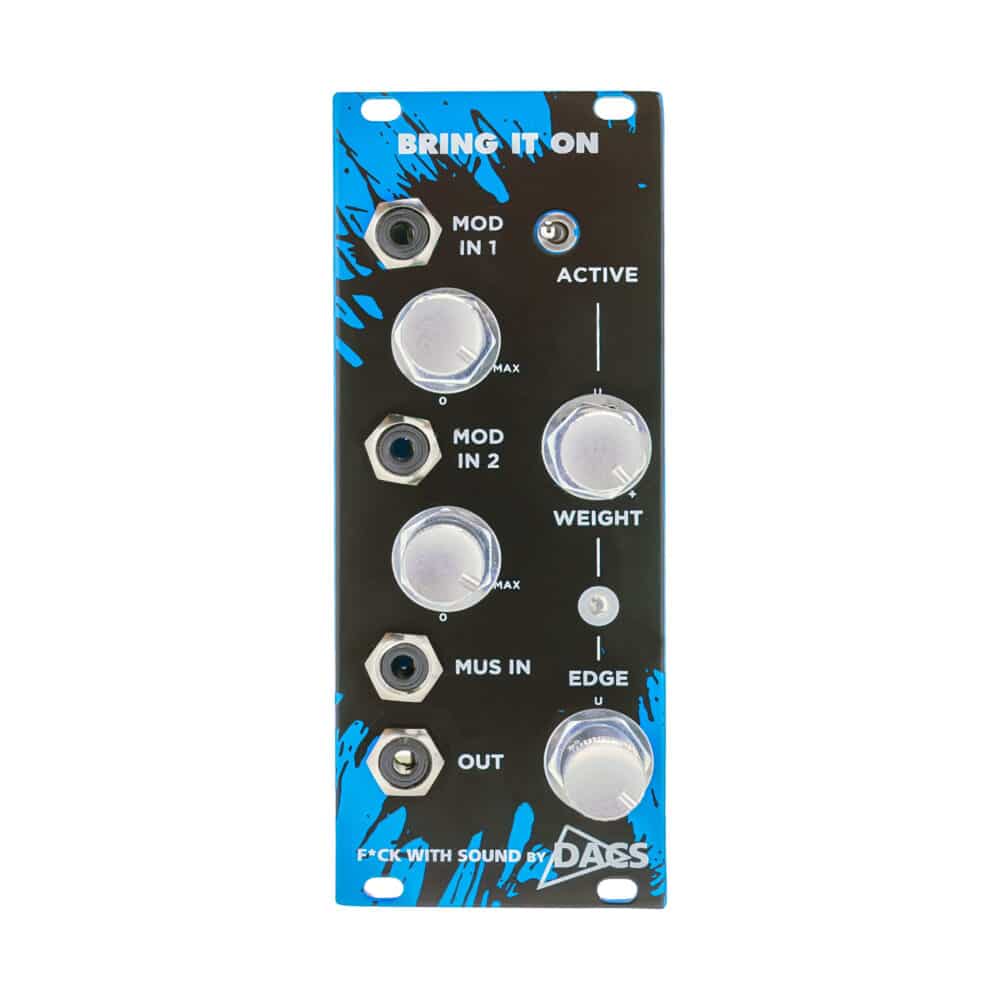
Bring It On is a ring modulator that offers some sweet possibilities for classic metallic and clanky ring modulation sounds as well as weird, noisy, and unworldly sonorities that encourage all sorts of experimentation.
WHAT IS RING MODULATION?
Before I get into the specific features, below is a short definition of ring modulation and how it works. Ring modulation is a form of amplitude modulation in which one oscillator (the modulator) modulates the amplitude of another oscillator (the carrier). In the purest form, sine waves are used for both carrier and modulating frequencies, resulting in two additional frequencies known as sideband frequencies:
- Sum Tone = [Carrier Freq + Modulator Freq]
- Difference Tone = [Carrier Freq – Modulator Freq]
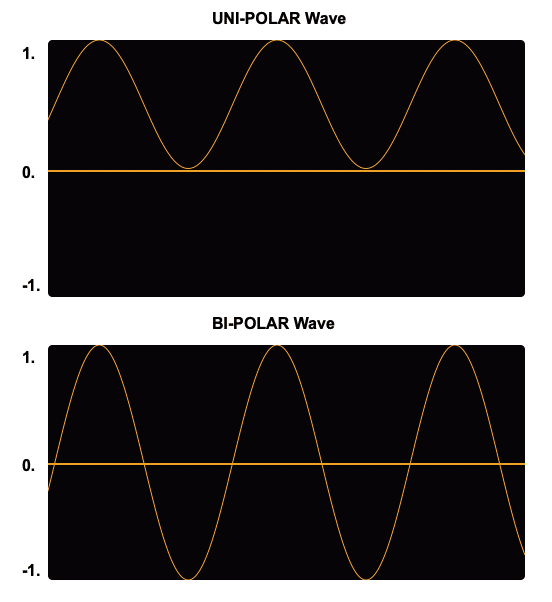
In ring modulation, the carrier frequency is eliminated, which can be useful for pitch transposition where the original pitch needs to be removed (Russ 162). This is because ring modulation uses two bipolar signals, creating periodic zero-crossing points, whereas in AM, a bipolar signal is modulated by a unipolar signal (Roads 216).
Below are examples of bipolar and unipolar signals:
With sub-audio modulating frequencies (below 20Hz), ring or amplitude modulation is heard as a tremolo effect (up to about 16Hz). Higher modulating frequencies begin to generate the audible sidebands mentioned above.
For example, a carrier frequency of 400Hz and a modulating frequency of 100Hz will yield sideband frequencies of 300Hz and 500Hz. If the difference tone results in a negative number, the frequency is wrapped back into the positive domain. For instance, a difference tone of -250Hz would become +250Hz, which may result in difference tones that are much closer to the sum tone or the carrier frequency in the case of amplitude modulation (Creasey 563).
REDUCED LEAKAGE
One typical issue with analog hardware ring modulators, as opposed to digital systems or software, is the leakage of the carrier frequency into the resulting sound. Theoretically, when pure sine waves are used as both carrier and modulating frequencies, there should only be two resulting frequencies (the sum tone and difference tone as described above). But some leakage of the carrier frequency does occur in analog systems. According to Douglas Doherty from F*ck With Sound, they have reduced leakage to an inaudible -65dB (as per their spec):
…we use TWO ring modulators, one with no audio input but with carrier in. We invert that carrier out and mix it with the out from the main modulator and then trim to cancel as much as we can.
For more details on AM synthesis and Ring Modulation, see my article, The Fundamentals of AM Synthesis or check out the excellent references at the end of this review.
BRING IT ON – FEATURES AND CONTROLS
This module features three inputs – two mixable DC-coupled* modulation inputs and a music input. There is also a switchable Weight/Edge section that engages a high and low shelving EQ for quick filtering. This is a solid build with custom metal knobs and Omeg ECO pots.
*Side Note: Good article here on the difference between AC and DC coupling.
BRING IT ON – SPECS
Frequency Response
MOD Inputs: DC – 20kHz
MUSic Input: 5Hz – 20kHz
Size: 10 HP
Depth: 48.5mm
Current Draw
+12V 18mA
-12V 14mA
+5V N/A
Cost: See product page for current pricing.
BRING IT ON – EXAMPLES
Below are some examples using Bring It On with various inputs and a touch of verb.
Sequence with sine wave inputs
Sequence using a square wave
Sequence using with noise input
Sequence using with noise input + Mod 2
Drone using input from the delicious Benjolin rungler circuit by the late great, Rob Hordijk
Drone using Benjolin rungler circuit + Valhalla Shimmer
BREAK ON THROUGH
Break On Through is an FET limiter and distortion device fashioned after and inspired by the Shure Level-Loc limiter— used by myriad engineers over the years to compress, saturate, squash, and mangle everything from drums to vocals to guitars. While being very effective on drums, it is usable in a variety of contexts where you want more intense compressed sounds, increased overall loudness, or complete annihilation.
The Shure Level-loc has been emulated in several plugins, such as the Devil-Loc from Sound Toys and the Shure Level-Loc plugin from Korneff.
The character of the Level-Loc attack and release is a big part of the sound people love. The more you drive the Level-Loc, the more it will start to break up, eventually reaching heavily distorted sounds. It was not designed for drums and other sources. In fact, in a twist of irony, at the time the Level-Loc was made, the primary goal was to minimize distortions and artifacts, not to accentuate them! (source)
BREAK ON THROUGH – FEATURES AND CONTROLS
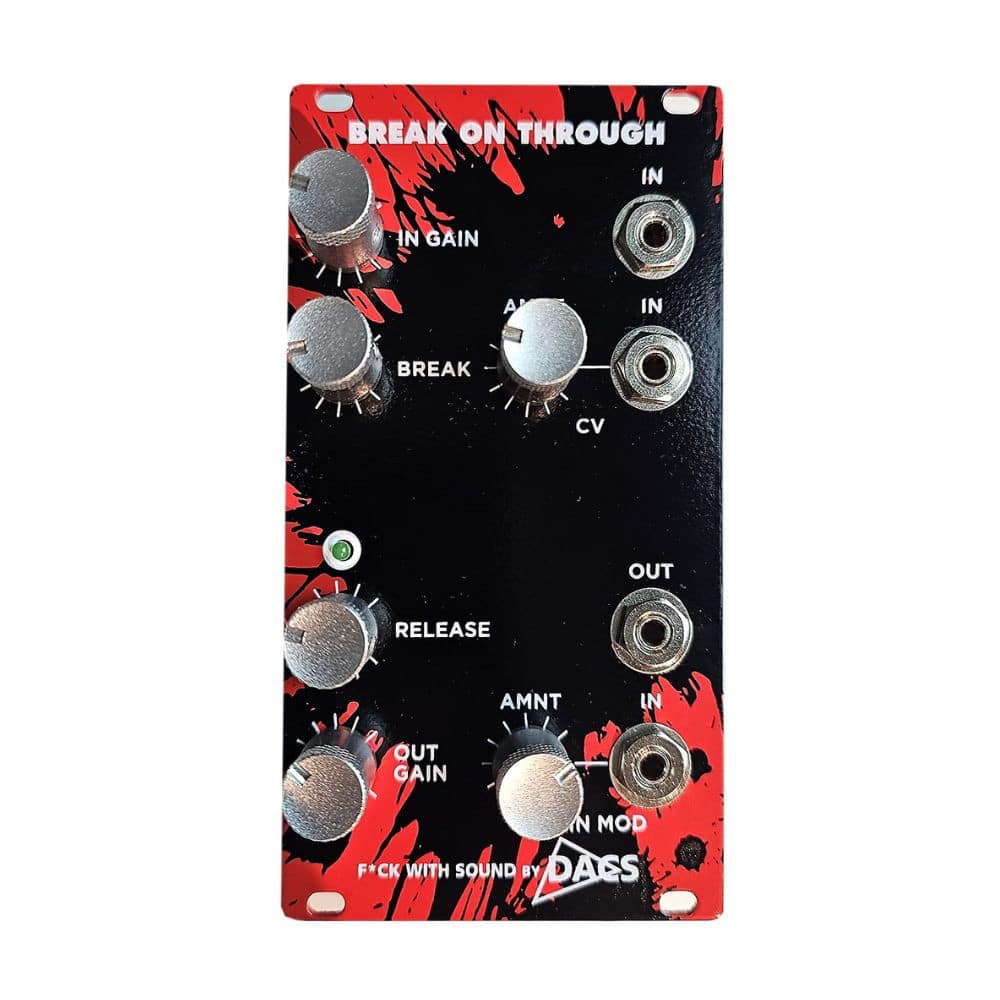
As with the Bring It On module, this piece has custom aluminum knobs in a rock-solid build. The unit features CV inputs and intensity controls to modulate amplitude and threshold (Break), input and output gain controls, and a Release control to further shape the distortion.
BREAK ON THROUGH – SPECS
Size: 14 HP
Depth: 35mm
Current Draw:
+12V <20mA
-12V <15mA
+5V N/A
Cost: See product page for current pricing.
BREAK ON THROUGH – EXAMPLES
Examples below illustrate processing a drum loop with Break on Through and increasing levels distortion.
Drum loop – dry
Variation 1
Variation 2
Variation 3
WHAT ELSE TO EXPECT FROM F*CK WITH SOUND
I asked Douglas Doherty what other new devices are in the works:
The FwS modules are analogue – we stick to analogue because we’re very good at it. We take it to the outer limits of audio performance. We make devices where you put something in one end and get a non-predictable/non-boring, and very musical output. I come up with functional ideas for processes. Ron Berry and I discuss possibilities/options, and Ron develops the electronics to achieve them. Our approach is to make processors that are nuanced and creative, aimed at imaginative musicians. The range of interactions, between subtle and extreme effects, allows everyone to F*CK WITH SOUND their way – our raison d’être!
We have one item well into the process of development: A voltage-controlled filter called FFF, all analogue, with opto control, 24dB and 12dB/octave, various modes, outstanding sound…
There are a number of other ideas in gestation, including our take on wavefolding from a different angle (Border Scout), and a multi-segment envelope shaper (Shape Shifter).
CONCLUSIONS
These two superbly engineered modules from FwS can be inspiring catalytic additions to your existing Eurorack system. Bring It On offers sonic possibilities that go well beyond the iconic metallic and clangy sounds expected from traditional sine wave-based ring modulation. Experimenting with other waveforms or audio signals and shaping the results with the Edge and Weight shelving filters can result in unexpected and delicious analog juiciness not possible in the digital realm.
The Break On Through module brings the sought-after distortion effects of the classic Shure Level-Loc into the Eurorack domain. As described by the developer:
…it’s clean to the distortion point. It’s basically a limiter with distortion at the threshold. Working with the input gain and threshold control you can control when and how much it distorts. It needs a little bit of experimenting to get the right balance. The output gain lets you up the level if you’re really crushing it.
These two devices are refreshing approaches to classic synthesis and audio processing techniques that are sure to impress even the most seasoned Eurorack synthesist. I highly suggest removing some of the dead weight in your rack to make room for these beasts from F*ck With Sound! As opposed to other things you may have f*cked with in the past, this you won’t regret.
REFERENCES
Creasey, D. J. Audio Processes: Musical Analysis, Modification, Synthesis, and Control. Routledge, 2017.
Reid, Gordon. “Amplitude Modulation.” Soundonsound.com, Sound on Sound, 1 Mar. 2000, www.soundonsound.com/techniques/amplitude-modulation.
Roads, Curtis. The Computer Music Tutorial. MIT Press, 2012.
Russ, Martin. Sound Synthesis and Sampling. Focal Press, 2013.
EXTRAS
Want to win a free license to Kontakt 8? Be one of the first 1000 people to FOLLOW WAVEINFORMER ON INSTAGRAM to be automatically entered to win one of three full-version Kontakt 8 licenses! Read more.
Assess your knowledge of essential audio concepts using our growing catalog of online Quizzes.
Explore more content available to Subscribers, Academic, and Pro Members on the Member Resources page.
Not a Member yet? Check the Member Benefits page for details. There are FREE, paid, and educational options