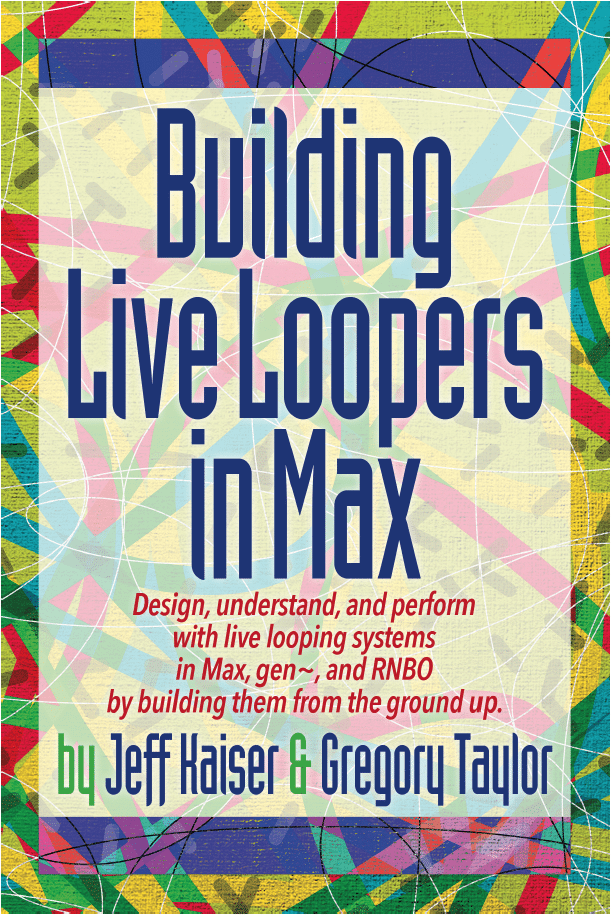
Building Live Loopers in Max is a recent book by Jeff Kaiser and Gregory Taylor—two icons of the Max/MSP world. The work is a long-awaited examination of looping as a creative practice, using implementation strategies and approaches demonstrated in the included Max/MSP patches compiled as a downloadable package.
SIDE NOTE: For those new to the software—Max/MSP is a graphic object-oriented programming language that allows for the creation of custom software (with little or no code-based skills). It has several related object collections for video manipulation and image generation (Jitter), code-based integration and sample-level manipulation (gen~), and cloud-based compilers (RNBO~). To learn about the history and creative possibilities of Max/MSP, see my article: “Max/MSP: The History and Utility of this Iconic Language from Cycling ’74”
WHO SHOULD READ THIS BOOK
Readers should have a fundamental understanding of the basics of Max programming, which can be self-taught through the tutorials that come with the program. That said, the authors do an excellent job of describing the functionality of all the objects used in the example patches and the programming concepts used to create useable patches designed for live performance.
Experienced Max users will benefit from subtle programming tips and conceptual approaches that may have eluded them in the past. And for those who have not explored looping in depth, this is an excellent place to start.
There are chapters that focus on creating loopers with gen~ and rnbo~, which provide a nice introduction to these environments for those unfamiliar and curious. For educators, this book is an ideal teaching tool that can provide immediate rewards for students just beginning to program in Max.
BUILDING LIVE LOOPERS IN MAX – CONTENT
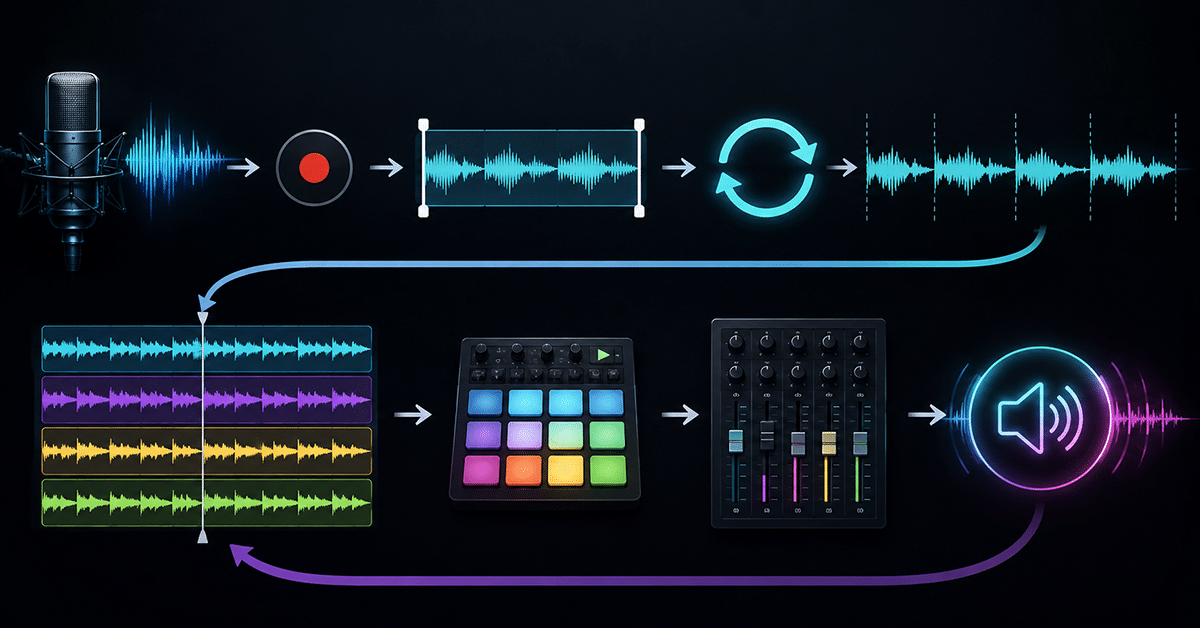
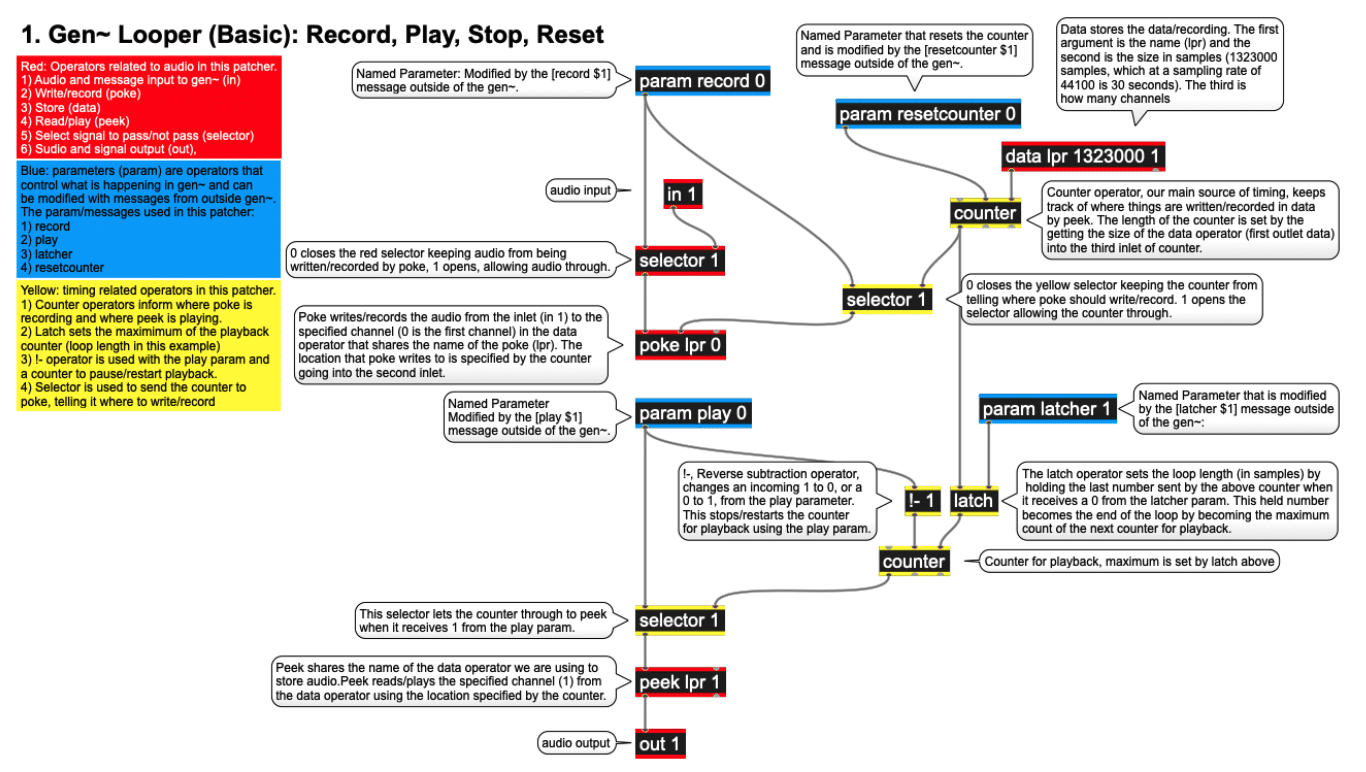
After a brief introduction to looping as a creative practice, the subsequent chapters demonstrate various implementations using traditional Max/MSP objects, gen~ and rnbo~. Concepts such as tape-style looping, multitrack looping, synchronous and asynchronous looping, varispeed effects, pitch-shifting, playback direction shifts, distortion and filtering effects, declicking, variable loop lengths, cross-platform deployment, interface design, and overdubbing are explored with excellent example patches that outline the step-by-step programming method used to create the final performance interface. Useful sections on encapsulation and abstractions will help keep your patches organized and create functional bits of programming that can be used across multiple patches.
Patches are available along with the book download at a pay-what-you-want price!
These patches offer insights and best practices from experienced Max programmers and provide the opportunity to expand and customize the software to suit your own needs and creative approach. One of the hallmarks of a great Max/MSP book is one that inspires you to start immediately creating new patches, even before you finish reading it. This book does exactly that.
CONCLUSIONS
As mentioned in the Introduction:
Contemporary looping is also a practice with deep roots in experimental Western art music, including the work of Pierre Schaeffer, Terry Riley, Alvin Lucier, Pauline Oliveros, Gordon Mumma, Steve Reich, as well as collaborations by Robert Fripp and Brian Eno, and artists such as David Torn, Laurie Anderson, Pamela Z, and William Basinski. Looping has found love in popular music among artists like KT Tunstall, Imogen Heap, Reggie Watts, Ed Sheeran, St. Vincent, and many more.
Repetition is a musical element found in almost all genres in one form or another. Formally, it can provide an arc of memory that lends to the cohesion of a work. Looping takes the idea a bit further, where short loops can create complex rhythmic gestures that can evolve or simply remain static as a backdrop to other musical movement. Even very short, noise-based loops can offer a surprising variety of listening experiences depending on how or what you focus on during active listening. While this book focuses on live looping, there is absolutely no reason these concepts can’t be used to generate material for fixed media or content for any musical production or context.
One thing not mentioned in the book and perhaps considered assumed knowledge is that all UI parameters can be mapped to an external MIDI controller, pedal, or the computer keyboard for on-the-fly adjustments.
This book is a welcome resource that serves to enrich the understanding of the fundamentals in the Max/MSP lexicon. The authors approach the subject of live looping from three distinct Max environments, using objects from the traditional Max/MSP collection, gen~ and rnbo~. The strategy emphasizes how similar results can be achieved in these different environments and the strengths and challenges of each programming method.
Beginners and advanced users will find useful information here that will strengthen your programming skills and offer new insights into looping praxis. Educators will find it can fit into Max/MSP courses at all levels and provide immediate inspiration for aspiring Max programmers.
Highly recommend!!
EXTRAS
Want to win a free license to Kontakt 8? Be one of the first 1000 people to FOLLOW WAVEINFORMER ON INSTAGRAM to be automatically entered to win one of three full-version Kontakt 8 licenses! Read more.
Assess your knowledge of essential audio concepts using our growing catalog of online Quizzes.
Explore more content available to Subscribers, Academic, and Pro Members on the Member Resources page.
Not a Member yet? Check the Member Benefits page for details. There are FREE, paid, and educational options